Lightweight stroller safety: the rules that matter
A lightweight stroller is light, and that is exactly why it needs a few precautions: it tips more easily, folds quickly and goes everywhere. Here are the standards to know, the habits that protect your child and the checks to make regularly.
Contents
Important: your stroller's manual and its warnings always take priority. This guide brings together general rules drawn from the recommendations of the French consumer safety authority (DGCCRF) and health authorities; it does not replace the manual or a health professional's advice.
Standards and markings
In Europe, stroller design is governed by the EN 1888 standard. Its first part, EN 1888-1, covers pushchairs and prams. Its second part, EN 1888-2, covers pushchairs for children over 15 kg and up to 22 kg. They are adopted as national standards across Europe (in the UK as BS EN 1888). These standards define, among other things, stability, strength, braking and locking systems, and the backrest angle for use from birth.
On regulation, the French public health website, relaying information from the French consumer safety authority, points out that in France the wording "Conforms to safety requirements" is mandatory on the product or its packaging for the childcare items concerned. A French consumer association advises checking that the stroller shows the European standard, the name of the manufacturer or retailer and a serial number.
This information is usually on a label attached to the stroller and in the manual. Keep a photo of the label: the serial number is needed in case of a recall or claim.
Choosing a safe product
The French consumer safety authority gives a few keys for choosing a safe childcare product. It recommends checking the soundness of the most heavily used parts, in particular the folding, braking and locking mechanisms, the harnesses and safety belts, and stroller wheels. It also points out that safety devices must not be operable, engaged or disengaged, by the child.
When buying, choose an identifiable seller, a manual in your language and a product that clearly states its minimum age, maximum weight and the standard it follows. Be wary of offers with no brand, no manual or an illegible label.
Locking the frame
A lightweight stroller folds quickly; that is its strength. It is also why you should always check it is locked in the open position before putting your child in. Listen for or feel the lock click, then press firmly on the handlebar: nothing should give.
If the lock becomes uncertain, the frame feels loose or you have to force it to engage, stop using the stroller with your child. Clean the joints, then contact customer service if the problem persists. Our guide to lightweight stroller care explains these checks.
The harness, every outing
Always strap your child in with the harness, even for a few metres, even if they are asleep, even if they are lying down. A child can slide, lean over, try to get out, or be thrown forward if the stroller hits a kerb. A 5-point harness is standard on today's strollers: two shoulder straps, two waist straps, one crotch strap.
- set the shoulder strap height level with your child's shoulders;
- tighten so you can slide one or two flat fingers under the straps;
- readjust whenever the season or clothing changes;
- do not let your child play with the buckle.
A very thick coat under the straps reduces real support. In winter, choose warm but not too bulky clothing and a blanket or footmuff over the harness.
The brake, every stop
Apply the brake as soon as you let go of the handlebar, even for a second: to open a door, pay, pick up a toy. A pavement that looks flat often slopes slightly towards the road. A lightweight stroller rolls easily, and a gust of wind is sometimes enough to move it.
Test the brake regularly on a slight slope. If it no longer holds firmly after cleaning, do not use the stroller on slopes and have it repaired by customer service.
The risk of tipping
A lightweight stroller tips backwards more easily than a heavy one. The most common causes:
- a bag hung on the handlebar: when your child gets out, the bag's weight tips the stroller;
- a child standing up or leaning out strongly;
- going up a kerb too abruptly, pressing too hard on the handlebar;
- an older child hanging on to the stroller or climbing on the footrest.
Put bags in the basket, within its load limit, or carry them on your back. Only add light accessories designed for the purpose to the handlebar.
Pinching when folding
A stroller's joints can pinch fingers, adults' as well as children's. Fold and unfold the stroller with children kept away, never with your child inside, holding it by the intended parts: handlebar, carry handle. On a folded stroller that does not lock, carry it by its handle so it does not partly unfold.
Never leave your child alone
Never leave a child alone in their stroller, even asleep, even for a few minutes, even in the building's hallway or outside a shop. They can slide, get tangled in a strap, overheat, or the stroller can be knocked over. For a long nap or the night, put them in a proper cot.
Heat, sun and cold
Babies regulate their temperature poorly, the French public health agency points out. Three rules:
- No fabric over the canopy: the Quebec public health institute points out that the temperature inside a covered stroller rises quickly. Use shade or a parasol instead.
- No direct sun for a child under one, according to the French public health website, and no exposure between 12 noon and 4 pm.
- In severe cold, cover head, hands and feet, and uncover your child inside heated places.
Never leave a child in a car, even in the shade, even for a few minutes. Our guide to walks in every season explains these habits.
Stairs, escalators and transport
- Do not use an escalator with a child in the stroller: take the lift, or the stairs with the stroller folded and your child in your arms.
- On stairs, do not carry the open stroller with your child in it, unless there are two of you holding the frame.
- On the bus or tram, apply the brake and keep a hand on the handlebar.
- On an underground or station platform, stay well back from the edge, brake on.
More advice in our article on lightweight strollers in the city and on public transport.
Accessories and their pitfalls
Accessories improve comfort, as long as they are suitable. The French consumer safety authority recommends never altering the design or intended use of a childcare product. In practice:
- preferably use the manufacturer's accessories or ones compatible with your model;
- no cushion, insert or mattress not provided for, which changes your child's position;
- no hanging toys with long ties near a baby's face;
- a well-fitted rain cover with ventilation, removed indoors;
- no sealed plastic cover on the stroller in hot weather.
Respecting weight limits
The stroller is approved for a maximum child weight, and its basket for a maximum load. Exceeding these limits takes the stroller outside the conditions under which it was judged safe. Do not let an older child ride with the younger one, do not let a child sit on the footrest, and do not load the basket beyond what the manual states. For the Urbino, Chicco states 22 kg for the child; one retailer gives 3 kg for the basket.
A second-hand stroller
A second-hand stroller can be perfectly safe. Before using it, go through the French consumer safety authority's list: unfold and lock it, press on the handlebar; apply the brake on a gentle slope and push; check the straps, buckle and stitching; check the wheels for play. Ask for the manual, or download it. Avoid a stroller with a home-made repair: the same authority advises against repairing a worn or damaged part yourself.
Product recalls
Manufacturers sometimes recall a model following a defect. In the European Union, recalls of dangerous products are published on the Safety Gate portal, and each country also publishes its own (in the UK, the Office for Product Safety and Standards). Note your stroller's reference and serial number, and check these sources from time to time, especially for a second-hand stroller. If you have a safety problem with a product, report it to your national consumer or product safety authority.
An older sibling around the stroller
An older brother or sister often wants to help: push, carry, climb on the footrest, hang on the handlebar. These actions are well meant, but a lightweight stroller copes with them badly. A child hanging on the back can tip it over; a child pushing alone can let go of it on a slope. Let the older child hold the handlebar beside you, on flat ground, never alone near the road. Explain that nobody climbs into the stroller with the baby and nobody plays with the brake. For long distances, a buggy board designed by the manufacturer for your model, where one exists, is safer than an older child hanging on the frame.
Precautions specific to newborns
With a newborn, a few extra precautions apply. Only use a stroller approved from birth, backrest in the flattest position and leg rest raised. Set the harness shoulder straps at the lowest height. Do not add a pillow or cushion not provided by the manufacturer. Keep the blanket under the arms, never over the face. Avoid outings in the heat of the day and never cover the canopy. And always stay close: a newborn cannot tell you they are too hot or badly positioned. Our article on lightweight strollers from birth explains the set-up.
Reading the manual, properly
The manual is often put away unread. It contains safety information specific to your model: minimum age and position for a newborn, maximum weight, basket load, compatible accessories, folding instructions, specific warnings. The French consumer safety authority recommends strictly following the conditions of use supplied by the manufacturer. Read it once all the way through before the first outing, keep it with the proof of purchase, and pass it on to anyone who will use the stroller.
When someone else pushes the stroller
Grandparents, childminder, babysitter, friends: other people will push the stroller. Take five minutes to show them folding, unfolding and locking, the brake, and how to adjust the harness and backrest. Remind them of the essential rules: harness fastened on every outing, brake at every stop, no bag on the handlebar, no fabric over the canopy. Leave them the manual or its download link. What seems obvious to you after months of use is not for someone discovering the model.
The checklist
Every outing
- Frame locked in the open position
- Harness fastened and adjusted
- Brake working
- No bag on the handlebar
- Canopy suited to the weather, nothing draped over it
Every month
- Brake tested on a slope
- Fold and lock checked
- Straps and buckle inspected
- Wheels and swivels cleaned
- Product recalls checked
Safety myths
"A sleeping baby does not need the harness": wrong, a bump can still throw them forward. "A flat pavement does not need the brake": many slope slightly towards the road. "A heavy stroller cannot tip": any stroller can tip if a bag hangs on the handlebar. Simple habits protect better than assumptions.
The Urbino's safety points
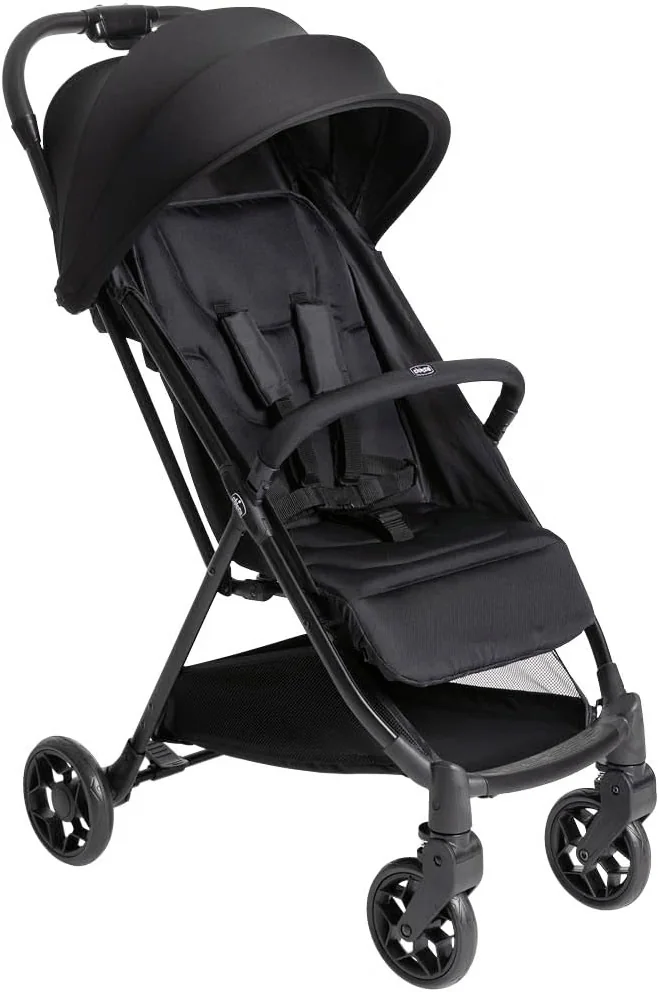
For the Urbino, Chicco states approval from birth to 22 kg, a 5-point harness with padded shoulder straps according to retailers, a foot brake and a bumper bar in front of your child. The folded stroller stands on its own; one buyer reports there is no transport lock: carry it by the bumper bar, which acts as a handle. Like any lightweight stroller, it copes badly with a heavy bag on the handlebar. Our user guide explains the lock, harness and brake.
Frequently asked questions
Which standard must a stroller meet?
In Europe, EN 1888-1 for pushchairs and prams, supplemented by EN 1888-2 for pushchairs for children over 15 kg and up to 22 kg.
Should you strap in a baby who is lying down?
Yes, always. The harness stops your child sliding or being thrown forward in a bump.
Can you hang a bag on the handlebar?
Best avoided: a lightweight stroller can tip backwards when your child gets out.
Can a stroller fold up on its own?
If it is not properly locked, yes. Always check the lock before putting your child in.
Where can you check stroller recalls?
On the EU Safety Gate portal, with your national product safety authority, and on the brand's website.
How often should you check the brake?
Test it every month on a slight slope, and after every trip or knock. It should hold the stroller firmly.
Can an older sibling stand on the footrest?
No. It upsets the stroller's balance and overloads the footrest. Use a buggy board designed by the manufacturer if one exists.
Ready for the first walks?
From birth · 6.3 kg · One-hand fold · UV 50+ canopy. Price and colours change often on Amazon: check them, as well as the seller and the accessories included (a rain cover is not always supplied), before you order.
Check the price on AmazonAffiliate link · new tab