Lightweight stroller in the city: buses, underground, stairs and shops
Narrow pavements, packed buses, underground stairs, broken lifts: the city puts a stroller to the test every day. Here are the rules to know, the habits that make life easier and the mistakes that cost you.
Contents
Why a lightweight stroller suits the city
The city has its constraints: little room at home, short but frequent journeys, often crowded public transport, stairs everywhere. A heavy, wide stroller quickly becomes a burden there, literally. The lightweight stroller was designed for these constraints: it is light, narrow and quick to fold.
You still have to choose it well. In the city, three qualities make the difference every day: a one-hand fold, to fold while holding your child; a stroller that stands up once folded, to keep your hands free; and a modest width, to get through doors, ticket barriers and shop aisles. Our guide on how to choose a lightweight stroller explains these criteria.
On the bus
Rules vary from one network to another. In Paris, for example, the RATP publishes its own:
- no more than two open strollers on standard and articulated buses, only one on smaller midibuses and minibuses;
- with a folded stroller, you board by the front door;
- with an open stroller, you can board by the middle door, subject to the driver's agreement and validating your ticket.
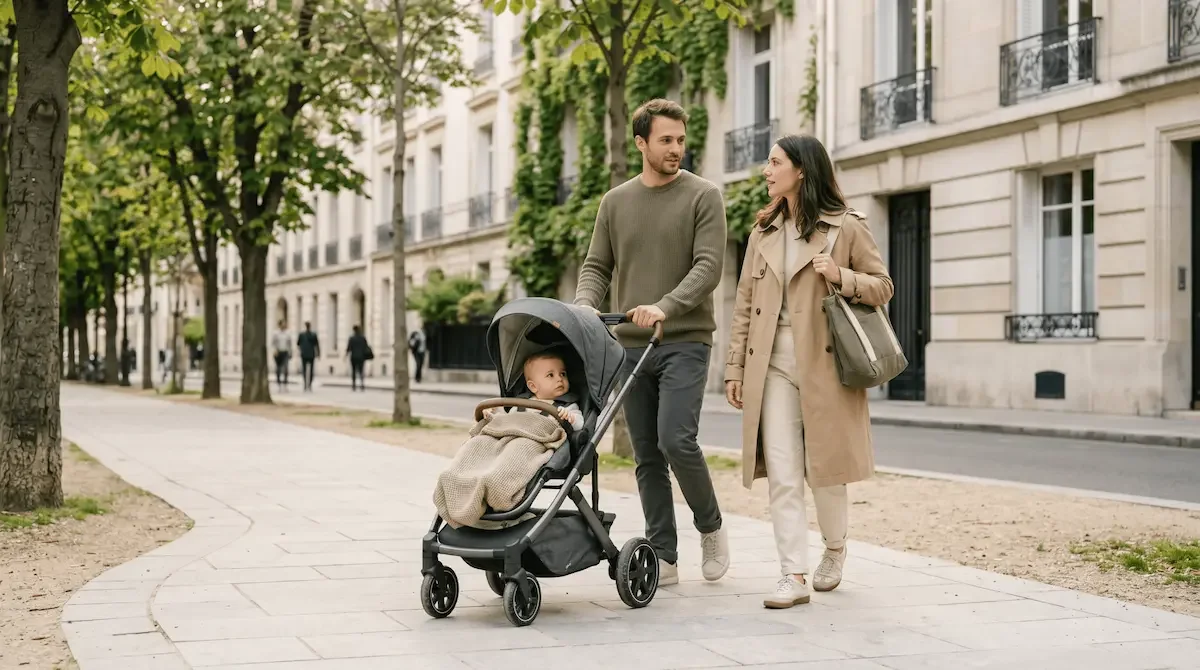
In practice, when the bus is full or the spaces are already taken, you have to fold. That is where a stroller that folds with one hand, your child in the other arm, changes everything. Once on board with the stroller open, apply the brake and position it backwards to the direction of travel if the space allows, holding it when the bus brakes.
Always check your own network's rules: they may set other limits, for example at rush hour.
On the underground and suburban trains
In Paris, strollers are allowed on the metro, ideally folded. The underground mainly poses an access problem: many stations have no lift or escalator in both directions. You then have to carry the stroller, and often your child.
- Find accessible stations on the network's maps and apps.
- Avoid rush hour if you can: an open stroller gets in the way, and folding in a crowd is hard.
- At ticket barriers, use the wide gate where there is one.
- On the platform, stay well back from the edge, brake on.
- On the train, stand near the doors without blocking the way, and hold the stroller.
On the tram
The tram is often the easiest transport with a stroller: low floor, step-free access, dedicated spaces. Board by the designated doors, use the reserved spaces without getting in the way of wheelchair users, who have priority, and apply the brake. Hold the handlebar: sudden braking can make even a braked stroller roll.
Stairs and escalators
On stairs, there are two techniques:
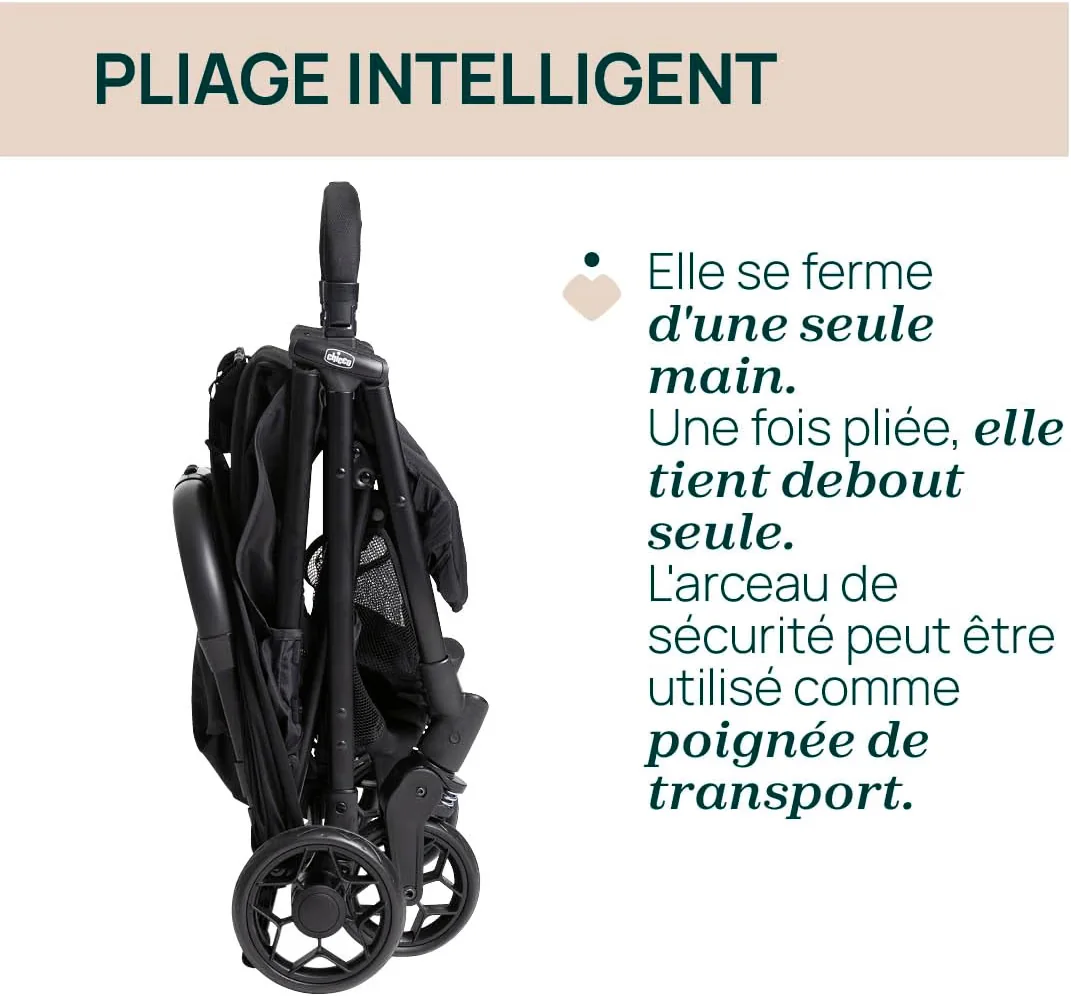
- Stroller folded: the safest. Your child in your arms or a carrier, the folded stroller carried by its handle. A lightweight stroller with a real carry handle, like the Urbino's bumper bar, is an advantage.
- Stroller open, child inside: best avoided. If you have no choice, get help: one person at the bottom, one at the top, each holding the frame, never a removable handle.
On an escalator, do not ride with an open stroller and a child in it: the risk of falling is real. Use the lift or the stairs, stroller folded and child in your arms.
Lifts and accessibility
Lifts are precious but not always working. Before an unfamiliar journey, check station accessibility and lift status on your network's tools. In a narrow lift, back in so you can come out forwards, and give priority to wheelchair users.
At home, measure your building's lift before buying a stroller: an 80 cm stroller, like the Urbino when open, fits in most lifts, but not always with an adult beside it.
Pavements, kerbs and cobbles
Small wheels are the Achilles heel of lightweight strollers. A few simple movements help:
- To go up a kerb, press down on the handlebar to lift the front wheels, set them on the pavement, then push to bring the rear wheels up.
- To go down, do the reverse, or go down backwards if the kerb is high.
- On cobbles, slow down: vibrations tire your child and wear the wheels.
- On a cluttered pavement, do not step into the road without checking the traffic.
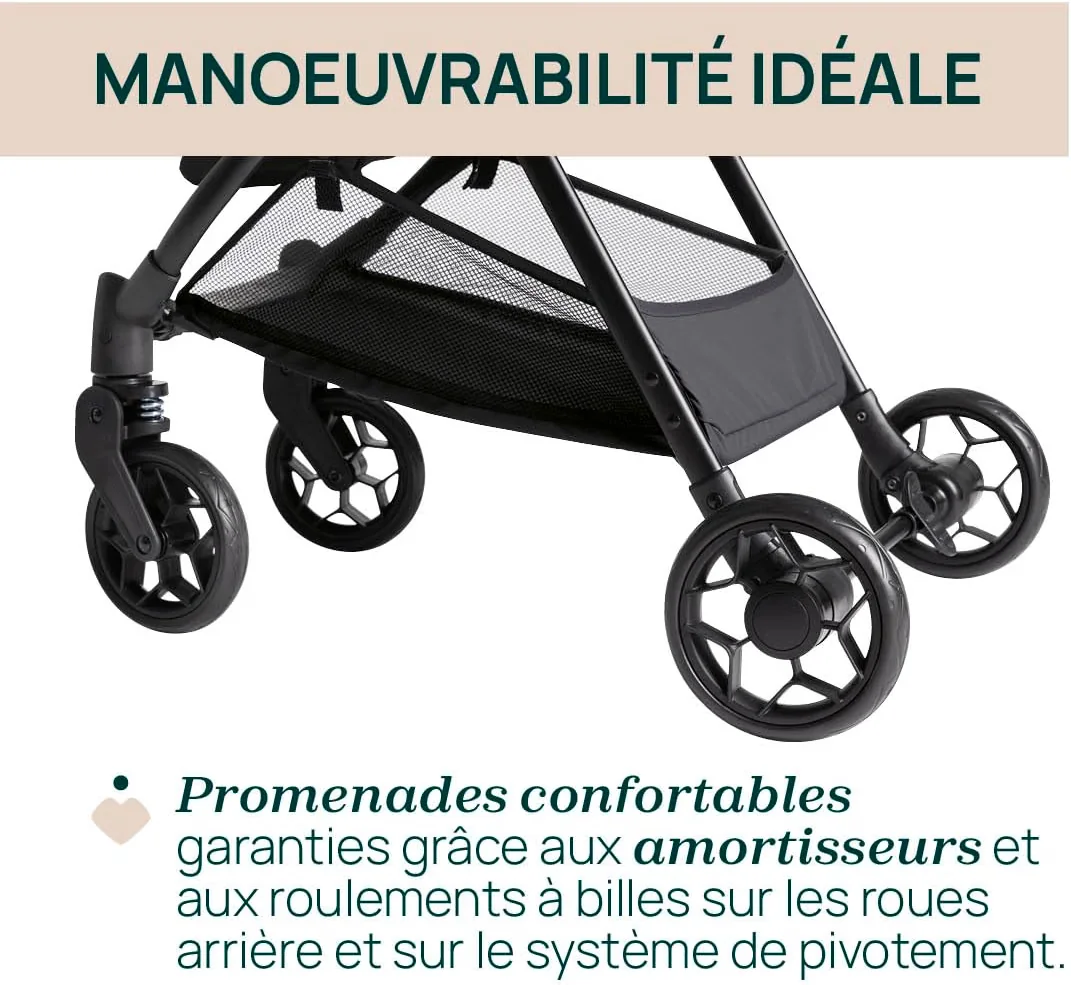
Shock absorbers and ball bearings, as on the Urbino, make these passages smoother, without turning a lightweight stroller into an all-terrain one.
Shops, cafés and markets
A narrow stroller fits through small shop doors, convenience store aisles and café terraces. A stroller you can steer with one hand leaves the other free for a basket or a coffee. A few habits:
- in a shop, do not fill the stroller's basket with unpaid items: it causes misunderstandings at the till;
- on a terrace, park the stroller against a wall, brake on, out of the way;
- at the market, keep your child away from stalls and crates;
- in changing rooms, back in so you can come out easily.
Nursery, childminder, school
Many nurseries and schools have a buggy store, often small. A stroller that folds quickly and stands on its own fits in without bothering others. Mark it discreetly (a label under the seat) to recognise it among identical models. If someone else collects it, show them the fold and the brake once: these are actions people assume are obvious and are not.
Your building and the buggy store
A ground-floor buggy store saves carrying the stroller up every day. Check that it is dry and locked. Do not leave valuables there. If you take the stroller up to your flat, a folded self-standing stroller stands upright in the hallway or a cupboard; at 25 cm deep, the Urbino takes little space.
Theft and damage
A lightweight stroller is easy to steal. Avoid leaving it alone outside a shop. In a shared storage room, lock it with a light lock through the frame, not a wheel or a removable handle. Take a photo of the serial number and the stroller: useful in case of theft or a dispute.
Habits that save time
- Fold the canopy back before reaching the bus stop.
- Keep the basket lightly loaded so you can fold quickly.
- Keep a light baby carrier in the basket for stairs.
- Find stations with lifts in advance.
- Allow a few extra minutes at rush hour.
- Always apply the brake when stopped, even for a few seconds.
Rush hour
At rush hour, everything gets harder with a stroller: packed buses, crowded platforms, passengers in a hurry. If you can, shift your journeys by a few minutes: leaving a quarter of an hour earlier or later often changes everything. If you cannot, be ready to fold: canopy back before you reach the stop, basket light, a carrier within reach. On the bus, if the stroller spaces are taken, wait for the next one rather than standing in the aisle with an open stroller. Drivers and other passengers appreciate it, and you travel more calmly.
Remember that priority rules exist too: wheelchair spaces are reserved first for wheelchair users. A stroller can use them when they are free, but must give way if needed.
Cyclists, scooters and cycle lanes
In the city, pavements are often shared with bikes, e-scooters and delivery riders. A stroller is low: a seated child is at handlebar height. A few simple habits reduce the risks. Do not cross a cycle lane without looking both ways, even if it is one-way. Avoid stopping on or beside a cycle lane. Coming out of a building or shop door, push the stroller out slowly: a cyclist can arrive fast on the pavement. And at night, make the stroller visible with a reflective strip or a small light.
The car in town
Even in the city, many families take the car for some trips: visits, heavy shopping, medical appointments. A folded lightweight stroller fits in a small car's boot, but city parking brings its own constraints: tight spaces, doors that only half open, sloping streets. Park on the pavement side if possible so you can take your child out away from traffic. Unfold the stroller on the pavement, brake it, then put your child in. Never leave an open stroller without the brake on near the road, even empty.
Choosing your route in the neighbourhood
With a stroller, the shortest route is not always the best. A two-minute detour along a street with wide pavements and dropped kerbs at crossings often avoids high kerbs, steps and pavements cluttered with bins or parked bikes. Find the passable streets in your neighbourhood, crossings with lights, parks with smooth paths and step-free shops. In the first weeks, try several routes: you will soon find the one that spares your arms and your child's sleep.
Rain in the city
In the city, rain complicates everything: slippery pavements, puddles at crossings, packed buses and hurried passengers. Keep the rain cover in the basket whenever rain threatens: the water-repellent canopy alone is not enough in a downpour. Inside a heated bus or shop, lift the rain cover to let your child breathe. On metal plates, painted crossing stripes and wet cobbles, slow down: a lightweight stroller slips more easily. When you get home, let the stroller dry open before folding it.
Accessibility and helping hands
Public transport is becoming more accessible, but not everywhere at the same pace. Network maps usually show stations with lifts and low-floor bus routes. Get into the habit of checking them before an unfamiliar journey, and keep a fallback if a lift is out of order: an alternative route, the bus rather than the underground, a carrier in the basket.
Do not hesitate to ask for help on stairs either: many passengers offer a hand spontaneously. In that case, fold the stroller if possible, carry your child yourself, and hand over the folded stroller rather than an open one with your child in it.
A typical city day
Morning: bus to nursery, fold at the stop with one hand, stroller standing while you validate the ticket. Midday: errands on foot, narrow shop doors, stroller steered with one hand. Afternoon: underground to the park, lift at the station if there is one, stairs with the stroller folded and your child in a carrier if not. Evening: dusk on the way home, a reflective strip on the frame, the stroller dried open in the hallway if it rained. A light, narrow stroller that folds quickly makes each of these moments simpler.
The Urbino in the city
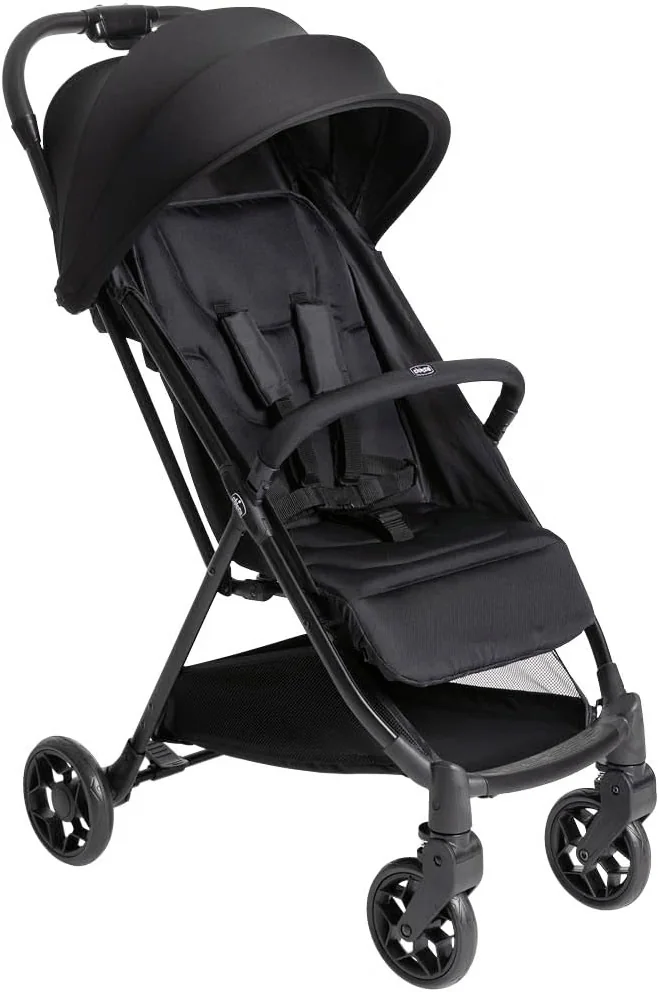
The Urbino was designed for this daily life: 6.3 kg, one-hand fold, self-standing, a bumper bar that doubles as a carry handle, 53 cm wide, shock absorbers and ball bearings. Its limits in the city are modest: a medium-sized basket and a fixed handlebar. For long connections with stairs, bring a light baby carrier as well. Our full review covers each point.
Frequently asked questions
How many open strollers are allowed on a bus?
It depends on the network. In Paris, for example, the limit is two on standard and articulated buses and one on midibuses and minibuses.
Which door should you use with a stroller?
In Paris, the front door with a folded stroller and the middle door with an open one, with the driver's agreement. Check your local rules.
Can you use an escalator with a stroller?
Avoid it with a child inside. Use the lift or the stairs, stroller folded.
Do you have to fold the stroller on the underground?
Many networks, including Paris, prefer it folded. At rush hour it is often essential.
What width gets through everywhere?
A width of around 50 cm gets through most doors and aisles. The Urbino measures 53 cm.
Do you need to fold the stroller at rush hour?
It is often necessary on buses and the underground. Get ready by folding back the canopy and lightening the basket before you reach the stop.
How do you get a lightweight stroller up a kerb?
Press down on the handlebar to lift the front wheels, set them on the pavement, then push to bring the rear wheels up. Go down backwards if the kerb is high.
Where should you leave the stroller at nursery?
In the designated store, folded if possible. A self-standing stroller takes less room; a discreet label avoids mix-ups.
Should you leave the stroller outside a shop?
Best not. A lightweight stroller is easy to steal. Take it in, or lock it by the frame in a shared store.
Ready for the first walks?
From birth · 6.3 kg · One-hand fold · UV 50+ canopy. Price and colours change often on Amazon: check them, as well as the seller and the accessories included (a rain cover is not always supplied), before you order.
Check the price on AmazonAffiliate link · new tab