How to choose a lightweight stroller: the complete guide
Minimum age, weight, fold, wheels, canopy, handlebar: a lightweight stroller is chosen on a dozen criteria, and above all on the way you live. Here is how to go through them, in order, without being caught out by product listings.
Contents
Start with how you will use it
The best way to get a stroller purchase wrong is to start with product listings. They talk about revolutionary folds, feather-light weight and premium comfort. They do not talk about your stairs with no lift, your small car's boot, your bus route or the dirt track that leads to the park. So start by describing your life, before you look at a single stroller.
Take five minutes to answer these questions, in writing if possible:
- How old will your child be when the stroller is first used? A newborn, a 6-month-old baby, a child who walks?
- Where will you walk most often? Smooth pavements, cobbles, park paths, country tracks, the beach?
- How will you get around? On foot, by bus, underground, car, train, plane?
- Where will you store the stroller? Hallway, cupboard, boot, buggy store?
- How many times a day will you fold it? Never, once, ten times?
- Who will push it? Just you, two parents of different heights, the grandparents, a childminder?
- Will it be your only stroller or a second one, for the car or holidays?
These answers will rank the criteria that follow. For a city family that folds ten times a day, the fold and the weight come first. For a family living in the countryside, wheels and suspension matter more. For grandparents who keep it in the boot, the folded size wins.
Minimum age and approval
This is the criterion that rules out the most models, and it is not negotiable. A stroller is designed and tested for a specific age and weight range. Putting a child outside that range, too young or too heavy, means leaving the conditions under which the stroller was judged safe.
In practice there are two families:
- Strollers from birth, whose backrest lies almost flat. They can take a newborn, provided the lying position is respected.
- Strollers from 6 months, designed for a child who can sit up. A French consumer association points out in its buying guide that some only accept children from 6 months, and that it is sometimes possible to add an optional carrycot.
On weight, most lightweight strollers stop at 15 or 22 kg. The European standards follow this logic: EN 1888-1 covers pushchairs and prams, EN 1888-2 pushchairs for children over 15 kg and up to 22 kg. A stroller approved up to 22 kg generally takes you to about 4 years, which often matches the end of regular use.
Where do you find the information? In the manual, on the label sewn or stuck on the stroller, and on the manufacturer's listing. A photo of a newborn in a stroller on a shopping page proves nothing. Our article on lightweight strollers from birth explains these checks.
Backrest recline
For a newborn, recline is a matter of safety and comfort: they cannot hold their head up and should not travel sitting. For an older child, it is a matter of naps: a backrest that lowers lets them sleep during the walk.
The EN 1888 standard sets, for a stroller usable from birth, an angle of at least 150° between the seat and the backrest. It is a useful reference for understanding listings: a "reclining" backrest with no further detail may only go down to 120° or 130°, which is enough for a 2-year-old's nap but not for a young baby.
Look at how the backrest is adjusted too:
- By strap: continuous adjustment, often one-handed, silent, but you sometimes have to support the backrest as you release it.
- By notches: fixed, clear positions, but the button is sometimes noisy or hard to reach.
A backrest you can adjust with one hand, without waking your child, makes a real difference every day. The leg rest matters too: raised, it extends the seat to form an almost continuous surface for a little one.
The stroller's weight
Lightweight strollers generally weigh between 5 and 8 kg, travel systems considerably more with their seat or carrycot. The difference looks small on paper, but you feel it on every stair.
Three tips for reading the weight correctly:
- Check what the figure includes. With or without wheels, bumper bar, canopy. Compare like with like.
- Think about the real weight: the stroller, plus what is in the basket, plus the rain cover, plus your child when you have to lift it up a step with them inside.
- Think about how you will carry it: a well-placed carry handle makes a 7 kg stroller easier to carry than a 6 kg one with nothing to hold.
Lightness comes at a price: the lightest models often save on recline, suspension, canopy size or frame rigidity. Look for the best weight for the features you need, not the lowest absolute figure.
The fold
If you fold often, this criterion can come before all the others. Not all "one-hand folds" are equal. Look at:
- The number of movements: a single motion, or a catch, then a push, then a lock?
- The position: is the control on the handlebar, or do you have to bend down to press a pedal?
- The canopy: does it need folding back first?
- The folded state: does the stroller stand on its own, lock, have a carry handle?
- Unfolding: as simple as folding, or more temperamental?
The ultimate test is folding the stroller while holding a 4 or 5 kg object in your other arm, such as a bag of flour or a pack of water bottles. If it is a struggle in the shop, it will be a pain at the bus stop.
A self-standing stroller, which stays upright once folded, changes a lot: you keep your hands free for your child, a door, a ticket. It also tucks into a corner more easily without sliding.
Open and folded dimensions
Open, the width decides whether the stroller goes through doors, shop aisles, ticket barriers and narrow lifts. Most lightweight strollers are between 45 and 55 cm wide. Measure the narrowest door in your daily life: often the lift or the bakery.
Folded, three figures count: height, width and depth. Measure your boot inside, between the wheel arches, and the height under the parcel shelf. Measure the spot where the stroller will live at home too. Our boot and cabin calculator compares these dimensions with those of the Urbino.
For flying, do not trust the word "compact": cabin bag sizes are around 55 x 35 x 25 cm. Only strollers specifically designed for this fit. Others travel in the hold or to the aircraft door.
Wheels and suspension
Wheels are the traditional weak point of lightweight strollers, because small wheels fold and store better. To judge them, look at:
- Diameter: the bigger they are, the better they get over obstacles.
- Material: hard plastic (noisy, catches on cobbles), EVA foam (puncture-proof, softer), pneumatic rubber (comfortable, but can puncture).
- Shock absorbers: on all four wheels or only at the rear.
- Ball bearings: smoother, quieter rolling.
- Front wheel lock: essential on gravel and dirt to go straight.
If you mostly walk on pavements, a well-sprung lightweight stroller is enough. If you walk a lot on tracks, a city pushchair with big wheels will be more comfortable for your child and your arms.
The canopy
The canopy protects from sun, wind and light rain. Three points to check:
- Its size: does it come down far enough to cover the face of a child lying down? Is it extendable, with an extra panel?
- Its treatment: a UV rating (often 50+) indicates the fabric filters ultraviolet rays. It only protects what is in the canopy's shade.
- Its water resistance: "water-repellent" means water beads for a while, not that the canopy is waterproof. For rain, you need a rain cover.
An important reminder: the canopy does not replace shade. Health authorities advise that children under one should not be exposed to the sun. And never drape fabric over the canopy for shade: the temperature rises quickly underneath.
Harness and seat
A 5-point harness (two shoulder straps, two waist straps, one crotch strap) is standard on today's strollers. Check:
- how easily the shoulder straps adjust in height and length;
- the buckle: firm enough that your child cannot open it, simple enough for you;
- the shoulder strap padding, which prevents rubbing on the neck.
For the seat, look at its width, depth and the height of the backrest. A shallow seat saves space at the fold, but a bigger child may slide forward in it. A high backrest is welcome for the nap of a 3- or 4-year-old.
The brake
The brake is the safety feature you use most often. The French consumer safety authority (DGCCRF) recommends checking its soundness, as well as that of the fold and lock. Choose a pedal that is easy to press with your foot, even in flat shoes, and releases without twisting your ankle. Test the brake on a slight slope: the stroller should not move, even by a few centimetres.
The handlebar
Two separate handles, as on traditional umbrella strollers, or a single bar: a single bar lets you push with one hand, separate handles often make for a lighter fold. Above all, look at the height. A handlebar that is too low forces you to lean over, which tires your back on a long walk. If the two parents are very different heights, an adjustable handlebar is a real comfort. On many lightweight strollers, it is fixed.
Basket and storage
The basket on lightweight strollers is often small, for folding reasons. Look at its maximum load, stated in the manual, and its access: a basket you can only reach with the backrest up is frustrating when your child is asleep. Avoid making up for a small basket by hanging a bag on the handlebar: a lightweight stroller can tip backwards.
Accessories
Compare what is really included in the box:
- Bumper bar: protects your child, sometimes doubles as a carry handle.
- Rain cover: often sold separately on lightweight strollers.
- Footmuff or leg cover: useful in winter.
- Travel bag: handy for flying.
- Insect net, parasol, cup holder: comfort items, rarely essential.
A slightly more expensive model with a rain cover included can work out cheaper than a bare model to which you will have to add everything.
Fabrics and care
A stroller gets dirty: crumbs, fruit purée, mud, sand. Check whether the fabrics are removable, machine washable or hand wash only, and whether the canopy comes off easily. Pale colours look lovely in the shop and show the dirt in real life. Our care guide explains the habits that extend a stroller's life.
Reading a product listing without being caught out
| Wording | What it means | What to check |
|---|---|---|
| "From birth" | Approved for a newborn | Age in the manual, backrest almost flat |
| "Ultra-light" | Low weight, often without accessories | What the figure includes |
| "One-hand fold" | Possible with one hand under certain conditions | Number of movements, canopy, position |
| "Compact" | Small folded size | The three real dimensions |
| "Cabin size" | Designed as a cabin bag | The dimensions your airline accepts |
| "Rain protection" | Water-repellent canopy or cover included | Rain cover in the box? |
| "All-terrain" | Bigger wheels or suspension | Wheel diameter and material |
| "Up to 4 years" | Average age guide | The maximum weight, which is what counts |
Try before you buy
If you can, try the stroller in a shop, or a friend's. Fold and unfold it three times. Push it with one hand. Go up a kerb. Brake. Adjust the backrest. Put the changing bag in. Ask the other parent to push it too. Ten minutes of testing saves a lot of regret.
If you buy online, keep the packaging while you do the same tests at home. The 14-day right to cancel lets you return a product that does not suit, under the conditions set by law and by the seller.
Which stroller for which profile?
| Your profile | What matters first | Recommended type |
|---|---|---|
| City family, public transport | One-hand fold, weight, width | Lightweight from birth, self-standing |
| Car-based family, newborn | Compatible car seat | Travel system, then lightweight from about 6 months |
| Countryside, tracks | Wheels, suspension | City pushchair with big wheels |
| Frequent flyers | Folded size | Cabin stroller |
| Grandparents, second car | Price, weight, simplicity | Simple lightweight, from 6 months if the child is older |
| Very tall parents | Handlebar height | Adjustable handlebar |
First or second stroller?
Many families first buy a travel system, then a lightweight stroller at around 6 months or 1 year, when the child can sit up and the travel system becomes bulky. This makes sense if you drive a lot in the first months.
Others choose a single lightweight stroller from birth, especially in the city. It is possible with a model approved from birth, as long as you accept a set-up that is a little less cocooning than a carrycot for the newborn, and no direct transfer from the car. Our umbrella or compact comparison helps you decide.
Buying second-hand
A second-hand stroller can be a great deal, provided you check a few points, those the French consumer safety authority (DGCCRF) lists among the most heavily used parts:
- Fold and lock: unfold, lock, press firmly on the handlebar. Nothing should give or snap.
- Brake: apply it on a slight slope and push. The stroller should not move.
- Harness: straps not frayed, buckle that closes firmly.
- Wheels: no excessive play, no cracks.
- Manual: ask for it, or download it from the manufacturer's website.
Avoid a stroller with a home-made repair on any part: the same authority advises against repairing a childcare product yourself.
Budget
We do not show prices, because they change often. Simply remember that the price of a lightweight stroller depends mainly on three things: approval from birth, the quality of the wheels and suspension, and the fold. An entry-level model may be enough as a second stroller for a child over 6 months. For a main stroller used every day for three or four years, it is often worth aiming for a better-sprung model that is easier to fold.
Your home: stairs, lift, storage room
Your home matters as much as your journeys when choosing a stroller. Walk the route between the street and your front door, and note every obstacle.
- Stairs with no lift: the stroller will be carried every day, often folded, with your child in your other arm. Weight and carry handle become priorities.
- A narrow lift: measure its depth and width. A stroller 80 cm long when open may force you to fold it every time if the lift is small.
- A buggy store: it lets you leave the stroller open, but check it is dry, and do not leave valuable accessories in it.
- A cramped hallway: a self-standing stroller, folded upright in a corner, goes unnoticed. A stroller that has to lie flat takes up the space of a piece of furniture.
- An old building: heavy front doors, steps at the entrance, narrow corridors. Open width and one-handed manoeuvrability help you get through while holding the door.
Think about where your child naps during the day too. If naps often happen in the stroller, in the hallway or on a shaded balcony, a backrest that lies flat and a covering canopy matter more.
An older sibling, twins, a second child on the way
The make-up of your family changes the priorities. With an older child who still walks slowly, a stroller you can steer with one hand leaves the other free to hold them. A buggy board fixed to the back, when the manufacturer allows it, can help on long distances; check compatibility in the manual before buying one.
For twins or two children close in age, a single lightweight stroller is not enough: you need a double stroller, side by side or tandem, which is much bulkier. Some families combine a double for long outings and a lightweight single for journeys where only one child rides.
If a second child is planned, think ahead: will the older child's lightweight stroller be used for the younger one? A stroller approved from birth then makes full sense, since it can take the newborn once the older child walks.
Thinking about the next three or four years
A stroller bought for a newborn may be used until they are 4. Over that time, your child will change weight, size and nap habits, and your journeys will change too: nursery, then school, perhaps a house move, different holidays. Before buying, picture the stroller in two years:
- will the seat and backrest be big enough for a napping 3-year-old?
- does the maximum weight leave a comfortable margin?
- will the wheels and fabrics stand up to daily use?
- does the brand offer spare parts or a reachable after-sales service?
A slightly sturdier stroller, chosen to last, often costs less than two successive strollers. And a well-maintained stroller is easier to sell or pass on.
Everyday ergonomics
Beyond the figures, a stroller is judged on ergonomic details you only notice with use. Can you work the brake in soft shoes without hurting yourself? Does the backrest strap or button fall easily to hand? Is the basket still reachable when the backrest is flat? Does the canopy open quietly, so as not to wake your child? Are the handles pleasant in cold weather? These small points make the difference between a stroller you enjoy using and one that annoys you every day. During a trial, take the time to do each of these actions at least once.
Five buying myths
A few beliefs come up again and again in parents' discussions. They are understandable, but they can steer you towards the wrong stroller.
- "The lightest stroller is always the best." Weight matters, but a stroller that saves a kilo by giving up recline or suspension may be less comfortable for your child and harder to steer on rough ground. Compare weight against the features you actually need.
- "A compact stroller fits in any cabin." Most do not. The common cabin size is around 55 x 35 x 25 cm, and only strollers designed for it get close. Check the three folded dimensions.
- "From birth means as comfortable as a carrycot." A stroller approved from birth is designed for a newborn, but it remains less cocooning and less flat than a carrycot. It is a mobility choice, not an identical alternative.
- "A more expensive stroller is necessarily safer." Safety depends on approval, the lock, the brake and the harness, which all models sold legally must address. Price often reflects comfort, materials and accessories.
- "You can sort it out later with accessories." Accessories help, but they do not change a fixed handlebar, a small basket or a minimum age. Choose the base stroller for your daily life first.
Keeping these points in mind will save you from paying for the wrong features, or missing the ones that count.
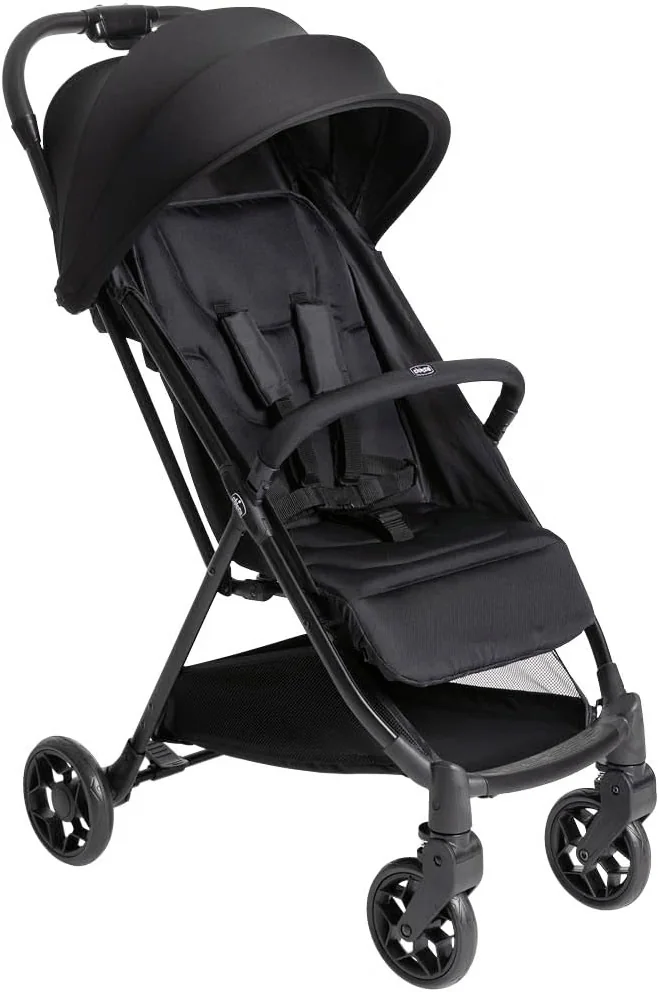
The Urbino against these criteria
| Criterion | Chicco Urbino |
|---|---|
| Age and weight | From birth to 22 kg |
| Recline | Fully reclining backrest, one-hand strap adjustment |
| Weight | 6.3 kg |
| Fold | One-hand, self-standing, bumper bar handle |
| Dimensions | Open 80 x 53 x 103 cm, folded 62 x 53 x 25 cm |
| Wheels | Shock absorbers, ball bearings, lockable front wheels |
| Canopy | Extendable, UPF 50+, water-repellent |
| Harness | 5-point, padded shoulder straps |
| Handlebar | Fixed, not adjustable |
| Basket | Up to 3 kg according to one retailer |
| Rain cover | Not listed among accessories |
For a city family looking for a single lightweight stroller from birth, the Urbino ticks the priority criteria. It suits very tall parents less well, as well as families who want to click in a car seat and those who mostly walk on tracks. Our full review covers each point in detail.
The final checklist
- The minimum age and maximum weight suit my child.
- The backrest lies flat enough for their age.
- I can carry it easily up my stairs.
- I can fold it with one hand, my child in the other arm.
- It fits folded in my boot and my hallway.
- It goes through my doors and my lift when open.
- Its wheels suit my journeys.
- The canopy covers my child well when lying down.
- The handlebar is at the right height for both of us.
- I know what is included in the box and what I will need to buy separately.
Frequently asked questions
What is the most important criterion?
The minimum age and maximum weight, because they determine safety. Next come the fold and the weight if you live in a city.
Is a lightweight stroller from birth as good as a carrycot?
No, a carrycot remains more cocooning and perfectly flat. A lightweight stroller from birth is a light compromise, suited to walks.
Do you need an adjustable handlebar?
It is useful if the parents are very different heights or one of them is very tall. Otherwise, a well-placed fixed handlebar is enough.
Double or single wheels?
Double wheels are often more stable, single wheels more manoeuvrable. Diameter and suspension matter more.
Do you need a rain cover?
If you go out in all weathers, yes. A water-repellent canopy is not enough in a downpour.
How long does a lightweight stroller last?
Up to the stated weight limit, often 15 or 22 kg. Many children use one until 3 or 4 for long outings.
Should the stroller be the same brand as the car seat?
Only if you want to click the car seat onto the stroller. Otherwise, choose each item on its own merits.
Is a heavier stroller safer?
Not necessarily. Safety depends on approval, the lock, the brake and the harness. A well-designed lightweight stroller is safe, as long as you do not hang a bag on the handlebar.
Ready for the first walks?
From birth · 6.3 kg · One-hand fold · UV 50+ canopy. Price and colours change often on Amazon: check them, as well as the seller and the accessories included (a rain cover is not always supplied), before you order.
Check the price on AmazonAffiliate link · new tab