Lightweight stroller from birth: what you need to know
Yes, a lightweight stroller can take a newborn, but not just any model and not just anyhow. Here is how to recognise a suitable one, how to settle a tiny baby in it, and what changes over the months.
Contents
Key point: a lightweight stroller can only be used from birth if the manufacturer clearly says so, and in the position intended for that age, with the backrest fully reclined. If you have any doubts about your baby's health or development, ask your doctor, health visitor or midwife.
Why the question arises
For a long time, the answer was simple: lightweight strollers were for later. In the first months, you used a pram, a carrycot or an infant car seat clicked onto a frame. The lightweight stroller came at around 6 months, when the child could sit up, often as a second stroller.
Things have changed. Many city families live without a car, in homes with no room for a pram, and use public transport every day. A heavy, bulky travel system quickly becomes a burden there. Manufacturers have therefore designed lightweight strollers whose backrest reclines far enough to take a newborn. These models have raised a fair question: is it just as good for the baby?
The answer comes in two parts. A lightweight stroller approved from birth is designed for this use, and it has been assessed under these conditions. But it remains a compromise: less cocooning and less flat than a carrycot. The key is choosing a model genuinely intended for this age, and using it as intended.
What a newborn needs
A newborn cannot hold their head up. Their neck and back muscles do not allow them to sit. In a stroller, they therefore need:
- a lying position, or almost, so that their head and back are supported;
- support that stops them sliding, without squashing them;
- protection against sun, wind and cold, because they regulate their temperature poorly, as the French public health agency points out;
- a smooth ride, which limits jolts.
A stroller that ticks these four boxes can be used for walks from the first weeks. One that ticks only two or three will have to wait a few months.
Approval: where to look
Trust neither the product name nor the photos. Three sources are authoritative:
- The manual, which states the minimum age and maximum weight, and often the required position for the youngest.
- The label on the stroller, which repeats the standard and the limits of use.
- The manufacturer's listing, on its official website.
Wording such as "0+ months", "from 0 to 22 kg" or "approved from birth" indicates use is possible from the first days. Wording such as "from 6 months" or "once the child can sit up" excludes a newborn. A French consumer association points out that some so-called "stage 2" strollers only accept children from 6 months.
Watch out for contradictions: the same stroller may be sold as suitable from birth in Europe and from 6 months in another country, because the rules differ. This is the case with the Urbino, sold from 6 months in the United States and approved from birth in its European version. For a purchase in Europe, refer to the manual of the European version.
The backrest angle and the standard
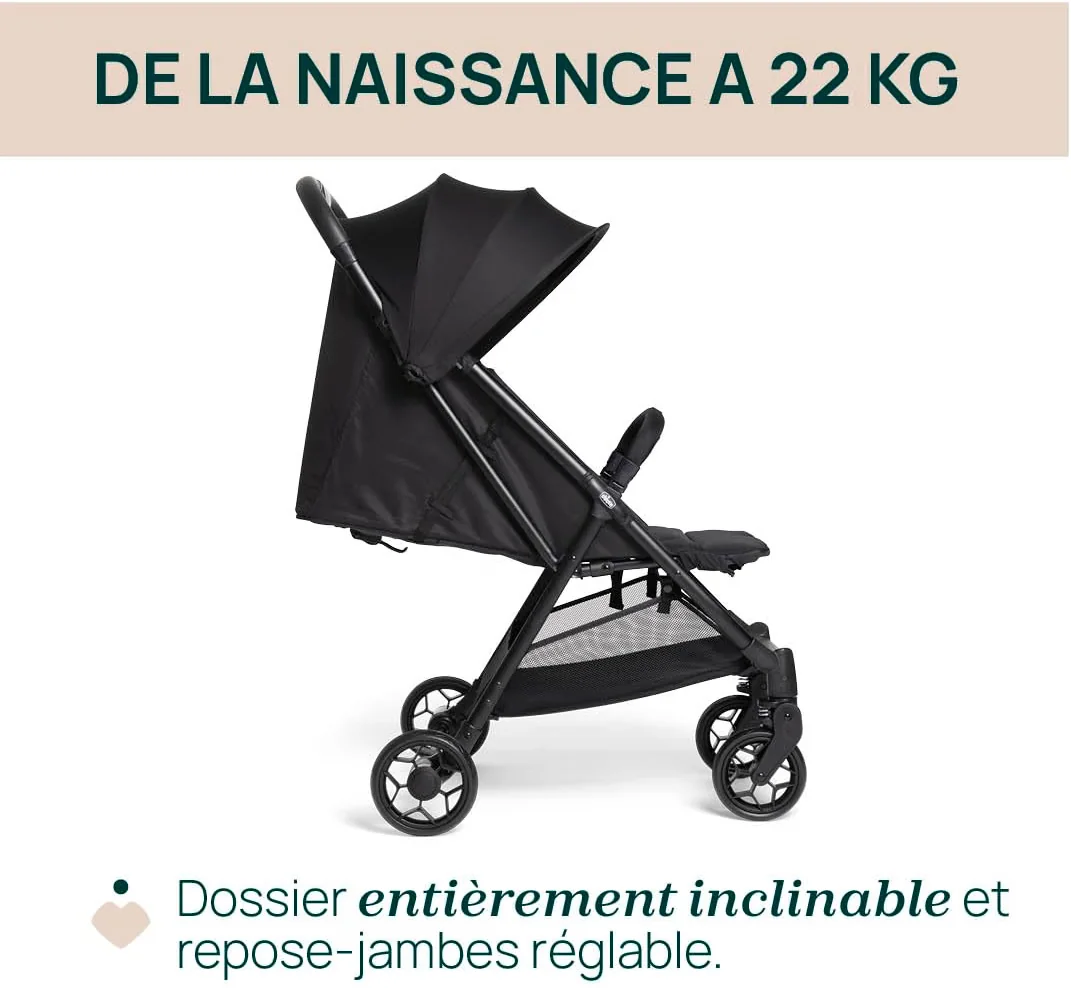
The European stroller standard, EN 1888, governs the design of pushchairs and prams. For a stroller to be suitable from birth, it requires an angle of at least 150° between the seat and the backrest, as several manufacturers point out. 180° would be perfectly flat; 150° is a slightly inclined surface, with the head a little higher than the feet.
Why not 180°? Because a stroller also has to fold, be carried and be used sitting up for years. Lightweight strollers from birth therefore aim for a "fully reclining" backrest within the limits of the standard, completed by a leg rest that lifts to extend the seat.
If the listing gives no angle, at least check these three points: does the backrest go almost horizontal? Does the leg rest lift in line with it? Does the canopy come down far enough to cover a child lying down?
Lightweight stroller from birth or carrycot?
| Criterion | Lightweight from birth | Carrycot or pram |
|---|---|---|
| Newborn's position | Almost lying flat | Perfectly flat |
| Cocooning | Harness, canopy | Closed shell, apron |
| Weight and bulk | Light, compact | Heavy, bulky |
| Public transport | Practical | Difficult |
| Length of use | Up to 15 or 22 kg | A few months |
| Long naps | Possible during walks | More comfortable |
A carrycot remains more comfortable for a very young baby, especially on long outings. A lightweight stroller from birth is a mobility choice: it takes the newborn for walks and everyday journeys, and saves you buying, carrying and storing a second item. Our umbrella or compact comparison also covers travel systems.
Settling a newborn, step by step
- Apply the brake and check the stroller is locked in the open position.
- Lower the backrest to the lowest position, the one intended for newborns.
- Raise the leg rest to extend the seat.
- Open the harness and set the shoulder straps to the lowest height, level with the baby's shoulders.
- Lay the baby flat, back right in, head centred.
- Strap them in: shoulder straps, waist straps, crotch strap. Tighten until you can slide one or two flat fingers under the straps.
- Extend the canopy to protect them from wind and sun.
- Check that no blanket covers their face.
To cover a newborn, lay the blanket over them, tucked under the arms, never over their head, and never over the canopy. Adjust during the walk: an over-wrapped baby sweats, a cold baby has cool hands and neck.
How long in the stroller?
There is no official duration, and it depends on the stroller, the age, the weather and the child. For a newborn, short, regular walks are easier to manage: they leave time to feed, change and cuddle the baby between outings. Vary positions and supports through the day: arms, play mat, ergonomic baby carrier, stroller.
Watch for signs of discomfort: crying, restlessness, a baby who is sweating or cold. Stop, take them out of the stroller and carry on later. For any question about your baby's development or comfort, your doctor, health visitor or midwife remains the person to ask.
Naps in the stroller
Many babies fall asleep to the rocking of a walk. It is practical, and often precious for parents. A few simple rules:
- keep the backrest in the lying position for a tiny baby;
- stay close and never leave them unattended;
- no pillow, cushion or bulky soft toy near their face;
- no fabric over the canopy, even for shade;
- for night sleep or a long nap at home, use a proper cot.
What changes over the months
| Period | Position | What to watch |
|---|---|---|
| Birth to 3 months | Backrest fully reclined | Heat, cold, harness snug |
| 3 to 6 months | Backrest reclined, a little higher if the baby holds their head well | Curiosity, a baby who wants to see |
| 6 to 12 months | Backrest up when awake, reclined for naps | Hands grabbing everything, harness tight |
| 1 to 4 years | As preferred | Maximum weight, legs sticking out, a child who wants to get out |
These are guidelines only: every child develops at their own pace. The position depends on the manual and on what the child can do, not just on their age.
A newborn in heat or cold
A tiny baby regulates their temperature poorly. In hot weather, go out early in the morning or late in the day, seek shade and never cover the stroller with fabric: the Quebec public health institute points out that the temperature inside then rises quickly. The French public health website adds that children under one should not be exposed to the sun.
In cold weather, cover the head, hands and feet well, and use a footmuff or a blanket laid over the baby. The same French website advises choosing a stroller or pram rather than a baby carrier in severe cold, as a carrier can compress the legs. Once indoors, uncover them so they do not overheat. Our guide to walks in every season goes further.
Stroller or baby carrier in the first months?
Many parents hesitate between a stroller and a baby carrier for the first weeks. The two are not opposed: they suit different moments. A carrier keeps the newborn against you, warm, reassured by your voice and movements; it goes anywhere, up stairs and through crowded streets. A stroller relieves your back on long walks, carries the bag and the shopping, and lets the baby sleep flat.
The French public health website adds a useful nuance for severe cold: it then advises choosing a pram or stroller, because a carrier can compress the legs and increase the risk of frostbite to the feet. In mild weather, many families alternate: carrier for short trips and public transport, stroller for the park or the shops. To fit a carrier properly with a newborn, ask a midwife or a trained babywearing consultant.
The first outing after hospital
The first walk is often a moment that is both joyful and a little stressful. Prepare it the day before: stroller assembled and tested, harness set to the smallest size, backrest in the lying position, bag ready. Choose a short, familiar route, with places to stop, and a moment when the baby has just fed. Dress them for the weather without over-wrapping, and take a blanket to adjust. If you are going out alone for the first time, let someone close know your route. The first outings are also for finding your bearings: folding, unfolding, going up a kerb, braking. After a few days, these actions become natural.
Mistakes to avoid
- Putting a newborn in a lightweight stroller intended from 6 months, even propped with cushions.
- Sitting them up too early because they "want to see": wait until they hold their head well and follow the manual.
- Adding an insert or cushion not provided by the manufacturer.
- Covering the canopy with a blanket or muslin.
- Forgetting the harness because the baby is lying down.
- Leaving the stroller without the brake on, even when stopped on a flat pavement.
Questions to ask yourself before buying
Before choosing a lightweight stroller for a newborn, a few questions clarify your needs. Will you mainly walk, or drive with the baby asleep in a car seat? Do you have stairs to climb every day? Will a baby carrier take over for the first weeks? Will the stroller be used for long outings or for short trips around the neighbourhood? If walking and public transport dominate, a lightweight stroller approved from birth makes sense. If the car dominates, a travel system may suit the first months better.
The case of the Chicco Urbino
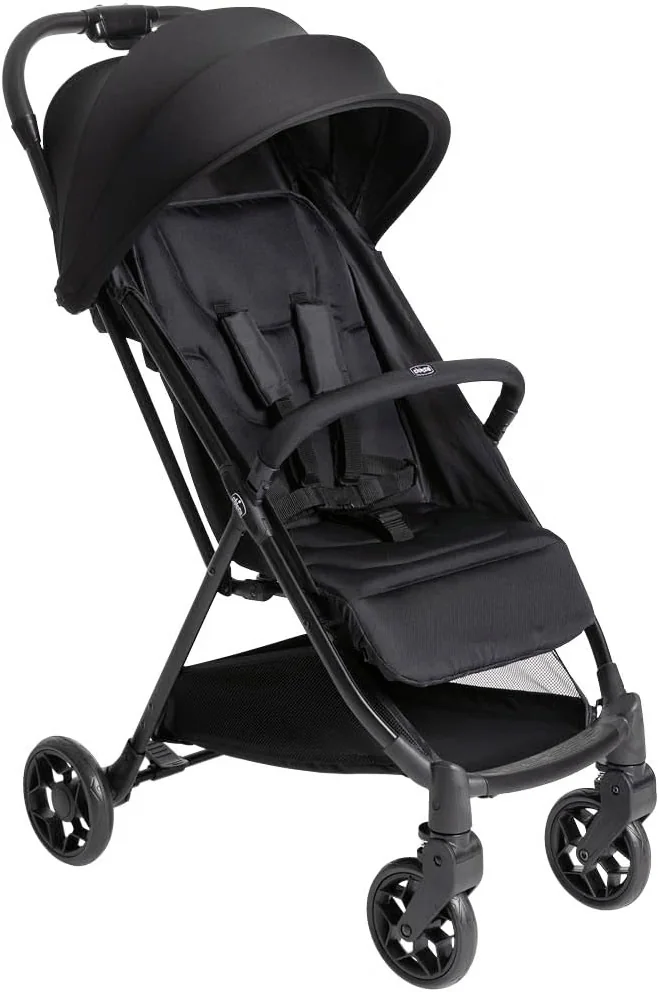
Chicco states the Urbino is approved from birth to 22 kg, about 4 years, thanks to its fully reclining backrest and adjustable footrest. The backrest adjusts with one hand via a strap at the back. For its US version, Chicco gives a recline range of 115° to 155° and recommended use from 6 months, which illustrates the difference between markets: in Europe, it is the European version, approved from birth, that is sold.
Its extendable canopy, treated to UPF 50+, comes down far enough to protect a newborn lying down. Its shock absorbers soften the ride. It is not a carrycot: for long outings with a newborn, the set-up remains less cocooning. Our Urbino review covers its strengths and limits.
Frequently asked questions
Is a lightweight stroller bad for a baby's back?
Not if it is approved from birth and used with the backrest fully reclined for a tiny baby. The problem comes from strollers intended from 6 months being used too early.
At what age can a baby sit up in the stroller?
When they hold their head and back well, often at around 6 months. Raise the backrest gradually and follow the manual.
Can you use a stroller insert?
Only if the manufacturer provides one for your model. An unapproved accessory can change the position and support.
Does a lightweight stroller from birth replace a carrycot?
For everyday walks, yes. For long outings with a very young baby, a carrycot remains more comfortable.
What does 0-22 kg mean?
The stroller is approved from birth up to a child of 22 kg. Weight is what counts, not age.
Can you alternate stroller and baby carrier?
Yes, it is common: carrier for short trips and stairs, stroller for long walks and flat naps. In severe cold, health authorities advise favouring the stroller.
When can the backrest be raised?
Once your child holds their head steadily, often after a few months. Raise it gradually and follow your model's manual.
Ready for the first walks?
From birth · 6.3 kg · One-hand fold · UV 50+ canopy. Price and colours change often on Amazon: check them, as well as the seller and the accessories included (a rain cover is not always supplied), before you order.
Check the price on AmazonAffiliate link · new tab