Umbrella or compact stroller: the real differences
Umbrella, compact, cabin, city, travel system: names change from brand to brand and categories overlap. Here is how to tell them apart on what really matters, and which one to choose for your daily life.
Contents
Names that overlap
Walk into a nursery shop and ask for a lightweight stroller: you might be shown one with curved handles that folds like an umbrella, one with a single handlebar that folds into a small package, or a "cabin" stroller for flying. All three are light, all three fold, all three are sold as practical. They do not meet the same needs.
The problem lies in the words. "Umbrella", "compact", "lightweight", "city", "travel" are not categories defined by a standard: they are marketing terms. Each brand uses them its own way. To choose, it is better to forget the label and look at five things: minimum age, weight, fold, folded dimensions and wheels. The families below are therefore guidelines, not watertight boxes.
The classic umbrella stroller
This is the ancestor of the family. Two separate handles, a slim frame that folds lengthways, a sling seat, small double wheels. It often weighs little, folds quickly and stands in a corner or lies in a boot. Its seat is generally simple, its backrest reclines little or not at all, and its wheels are made for pavements.
Strengths: lightness, simplicity, often affordable, narrow when folded.
Limits: rarely suitable before 6 months, two-handed steering, limited comfort on cobbles, little storage.
For whom: second stroller, the grandparents' car, holidays, a child who walks but tires on long distances.
The compact stroller
This is the category that has progressed most. Single handlebar, book-style or three-stage fold, often one-handed, better suspension, a bigger canopy, and sometimes a backrest that reclines enough for a newborn. It stays light but offers comfort close to a full-size pushchair.
Strengths: good balance between weight and comfort, quick fold, one-handed steering, sometimes usable from birth.
Limits: often an average basket, sometimes a fixed handlebar, not always compatible with a car seat.
For whom: main stroller in the city, families using public transport, parents who fold often.
Many parents call these models "lightweight strollers", and that is the meaning we give the term on this site: a light, compact stroller, whether or not it has curved handles.
The cabin stroller
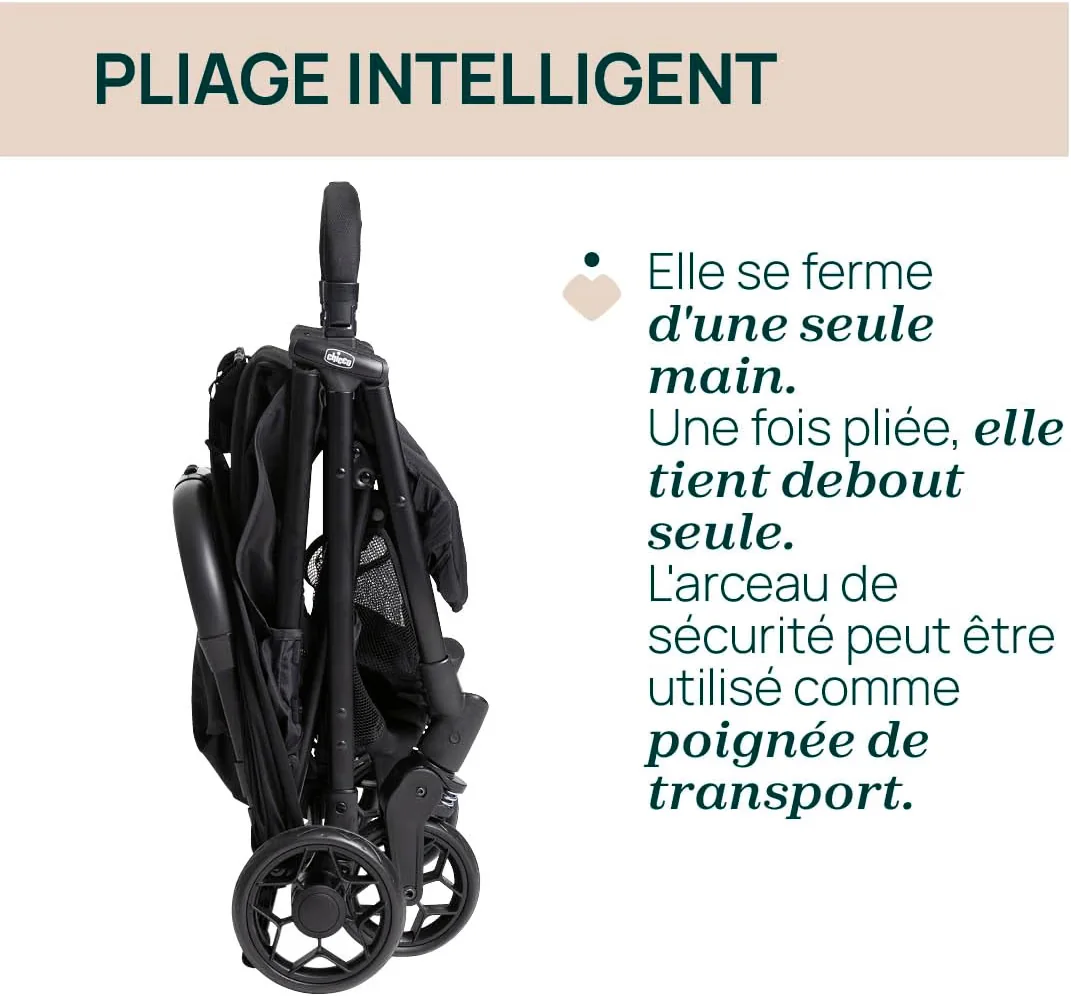
It takes the compact idea to its limit: once folded, it aims for cabin bag size, around 55 x 35 x 25 cm or less. To get there, it folds in several stages, its wheels are small and its seat often narrow. Some accept a newborn with a dedicated accessory.
Strengths: travels on board depending on the airline, minimal storage at home.
Limits: fold sometimes slower, less comfortable ride, accessories often extra. And even at the right size, an airline may ask for it to go in the hold if the lockers are full.
For whom: families who fly often, parents who want the smallest possible stroller.
The sturdy city pushchair
Sturdier than a compact, with bigger wheels, better suspension, a large basket and often an adjustable handlebar. Depending on the model, it can take a carrycot or a car seat. It weighs more and takes more space when folded.
Strengths: comfort on all pavements and paths, storage, durability.
Limits: weight, bulk, less practical on public transport and stairs.
For whom: families who walk a lot, on varied surfaces, and have space.
The travel system
Two-in-one (frame and seat, or frame and carrycot) or three-in-one (frame, carrycot and infant car seat), it accompanies the child from birth with the most cocooning solution. The car seat clicks onto the frame: you go from car to walk without waking the baby. A French consumer association considers it the most suitable if you want a very comfortable model for the first months, while noting that it is generally bulky, and points out that an infant car seat is not suited to long journeys because of babies' fragile backs.
Strengths: newborn comfort, car-to-stroller transfer, versatility.
Limits: weight, bulk, price, and often buying a lightweight stroller a few months later.
For whom: families who drive a lot with a newborn, have space and a lift.
The comparison table
| Criterion | Classic umbrella | Compact | Cabin | City | Travel system |
|---|---|---|---|---|---|
| Weight | Very light | Light | Light | Medium | Heavy |
| From birth | Rarely | Often | Sometimes, with accessory | Often | Yes |
| Fold | Lengthways, quick | Compact, often one-handed | Very compact, several steps | Compact, heavier | In two parts |
| Wheels | Small | Medium, often sprung | Small | Large | Large |
| Public transport | Very practical | Very practical | Very practical | Possible | Difficult |
| Aircraft cabin | No | Rarely | Depends on airline | No | No |
| Compatible car seat | No | Sometimes | Sometimes | Often | Yes |
These guidelines describe the tendencies of each family. Any model can be an exception: always check its listing and manual.
Three deciding criteria
1. Your child's age at the time of purchase
For a newborn, only strollers approved from birth qualify: reclining compacts, city pushchairs, travel systems. For a child over 6 months who can sit up, every family is possible.
2. Your main mode of transport
On foot and on public transport, lightness and a one-hand fold come first. By car, folded size and car seat compatibility matter. If you fly often, cabin size becomes decisive.
3. The surfaces you walk on
Pavements and town centres: a compact is enough. Old cobbles, park paths, tracks: bigger wheels and suspension make a real difference. Beach and snow: no lightweight stroller is at ease there.
Six situations, six answers
| Situation | Our advice |
|---|---|
| First child, city flat, no car | A compact approved from birth, self-standing |
| First child, house, car every day | A travel system for the first months, then a compact |
| 1-year-old, second stroller for the car | A classic umbrella or a light compact |
| Holidays by plane twice a year | A compact that travels in the hold or to the door is often enough |
| Flying every month | A cabin stroller |
| Country life, dirt tracks | A city pushchair with big wheels |
One stroller or two?
The classic pattern, a travel system then a lightweight stroller, still makes sense for many families. It has a cost, and it means storing two strollers for a while. The "single lightweight stroller from birth" pattern has spread in cities: it works if the stroller is genuinely approved from birth, and if you accept a less cocooning set-up than a carrycot for the first weeks.
There is a third pattern: a compact from birth as the main stroller, and an ergonomic baby carrier for the very first months and places where a stroller does not go easily. For a newborn, ask a midwife for help fitting the carrier properly.
Total cost, not just price
Comparing two strollers on purchase price alone is misleading. What counts is what you will spend in total over the period of use. A travel system looks expensive, but often includes carrycot, car seat and rain cover. A lightweight stroller looks cheap, but you may need to add a rain cover, a footmuff, a parasol and, if it is not approved from birth, another solution for the first months.
Do the sums on your real needs: how many strollers in total until your child is 4? Which accessories will be essential? A lightweight stroller approved from birth can work out cheaper than a "travel system then lightweight" pattern, provided it really meets your daily needs. We do not show prices, because they change often: compare like with like when you buy.
Resale and a second life
A stroller often has several lives: second child, cousins, friends, resale. Models from well-known brands, complete, with their manual and in good condition, find takers more easily. Think about it when you buy: a sober colour, washable fabrics and regular care make the next step easier. Before selling or giving it away, carry out the full inspection recommended by the French consumer safety authority (DGCCRF) on the fold, brake, harness and wheels, and honestly mention any known faults.
How to compare two models in a shop
If you are torn between an umbrella and a compact, or between two compacts, do the same trial run with each: fold and unfold three times, once holding a heavy bag in your other arm; push one-handed while weaving between the aisles; go up a small step; brake and push; adjust the backrest flat then upright; lift the folded stroller by its handle. Note your impressions right after each trial. Differences that seem minor on a spec sheet become obvious in five minutes of handling.
Hybrid models
The boundaries between categories are moving. Some compacts accept a carrycot or car seat with adapters sold separately, bringing them closer to a travel system. Some cabin strollers recline enough for a newborn with a dedicated accessory. Some city pushchairs fold almost as small as a compact. These hybrids can be a good compromise, provided you check three points: the real weight with the accessories you will use, the total price of adapters and accessories, and how easy it is to switch from one configuration to another. A stroller that is versatile on paper can become complicated if every change takes several minutes and leaves parts to store.
The most common buying mistakes
Three mistakes come up often. The first is buying a classic umbrella stroller intended from 6 months for a newborn, thinking you can prop them up with a cushion: that means leaving the approval conditions. The second is choosing a cabin stroller for daily life without trying it on your own pavements, and discovering that its small wheels struggle on cobbles. The third is buying a bulky travel system for a flat without a lift, then buying a lightweight stroller three months later.
The remedy is always the same: start from your real use, check the minimum age and maximum weight, measure your boot and doors, and try the stroller in conditions close to your daily life.
Four questions to settle before choosing
- How old will your child be on the first outing? Under 6 months, only models approved from birth qualify.
- How will you get around most? On foot and by public transport, lightness and a one-hand fold come first.
- Where will it be stored? Measure the hallway, the boot and the lift.
- Will it be your only stroller? A single stroller for four years justifies a sturdier model than a holiday back-up.
Answering these four questions usually narrows the choice to one family of strollers.
Where the Chicco Urbino fits
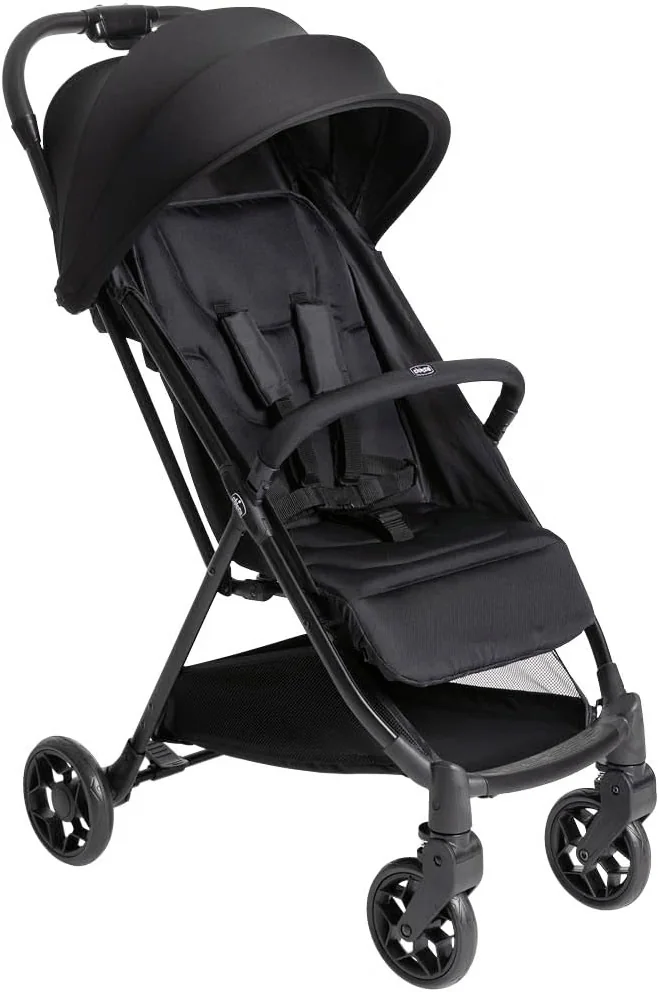
The Urbino belongs to the family of compacts from birth. It keeps the weight of an umbrella stroller, 6.3 kg according to Chicco, and adds the strengths of a modern compact: single handlebar, one-hand fold, self-standing, shock absorbers, extendable UPF 50+ canopy, fully reclining backrest approved from birth to 22 kg.
It is not a cabin stroller: folded, it measures 62 x 53 x 25 cm, beyond common cabin sizes. Nor is it a travel system: no compatible infant car seat, no carrycot. It is a main stroller for the city, or a comfortable second stroller for the car and holidays. Our Urbino review covers it in detail.
Frequently asked questions
Is a compact stroller an umbrella stroller?
In everyday language, often yes. Technically, the classic umbrella folds lengthways, the compact into a small package. What counts is the minimum age, the weight and the fold.
Which stroller for the underground?
A light compact that folds with one hand and stands up when folded. It is easy to carry on stairs.
Do you need a travel system for a first child?
Not necessarily. If you drive a lot with a newborn, it is practical. In the city, a compact approved from birth can be enough.
Is a cabin stroller enough for everyday use?
For some families, yes. But its fold and small wheels are designed for travel: try it on your pavements before making it your only stroller.
Which stroller for the countryside?
A city pushchair with big wheels and good suspension. A light umbrella stroller can be a second stroller for the car.
Does a compact from birth replace a travel system?
For many city families, yes. It does not take a car seat and remains less cocooning than a carrycot, which matters if you drive a lot with a newborn.
Which stroller for a second child close in age?
A double stroller, side by side or tandem. A light umbrella stroller can complement it for trips with only one child riding.
Is a hybrid model worth it?
If you really want to click in a car seat, yes. But check the weight with adapters and how quickly the change can be made.
Is a compact stroller harder to clean?
Not necessarily. What matters is removable fabrics and accessible wheels. Check the manual for how to wash the fabrics.
Ready for the first walks?
From birth · 6.3 kg · One-hand fold · UV 50+ canopy. Price and colours change often on Amazon: check them, as well as the seller and the accessories included (a rain cover is not always supplied), before you order.
Check the price on AmazonAffiliate link · new tab