Lightweight stroller walks: the guide to every season
July sun, January wind, April showers: a lightweight stroller goes out in all weathers. Here is how to prepare each walk, protect your baby without putting them at risk, and turn the daily outing into something simple.
Contents
Health note: the advice in this article is general. If your baby has a fever, drinks less, vomits or passes less, darker urine in hot weather, the French public health agency advises seeing a doctor quickly or going to A&E.
Why go out every day
A daily walk does everyone good. The baby discovers sounds, lights and faces, and enjoys the fresh air. The parent moves, sees people and gets out of the house. Many parents say the walk is also when the baby falls asleep most easily, rocked by the motion.
The Quebec public health institute puts it simply: a healthy baby can go outside every day, summer and winter, as long as the temperature seems reasonable and they are dressed appropriately. The whole art of the walk lies in those two conditions: choosing the right moment and equipping your child well.
A lightweight stroller is the ideal tool for these repeated outings. Light, it comes out and goes away in seconds. Compact, it goes everywhere. It is precisely because it goes out so often that you need to know how to use it in all weathers.
Preparing the outing in two minutes
A good walk takes two minutes to prepare, not twenty. Here is a simple routine:
- Check the weather: temperature, wind, rain, UV index in summer. The French public health website advises checking the UV index before going out.
- Choose the time: early morning or late afternoon in summer, the middle of the day in winter.
- Dress your baby for the weather, not forgetting head, hands and feet when it is cold.
- Check the stroller: brake, harness at the right length, canopy, basket not overloaded.
- Take the bag you prepared in advance.
With practice, these steps become automatic. Keep a walk bag ready by the door: all you need to add is the bottle or water.
The ideal bag
A lightweight stroller's basket is often modest: the Urbino's takes about 3 kg according to one retailer. So stick to the essentials.
Always
- Nappies and wipes
- A complete change of clothes
- Something to drink and eat, depending on age
- A cloth or bib
- A small bag for dirty clothes
- Phone and keys
Depending on the season
- Sun hat, light covering clothes in summer
- Hat, mittens, footmuff in winter
- Rain cover if rain threatens
- Stroller parasol in spring and summer
- An extra cardigan between seasons
Do not hang the bag on the handlebar: a lightweight stroller can tip backwards when your child gets out. If the basket is not enough, use a backpack.
Sun
The official rule is clear. The French public health website, which relays the French Ministry of Health's recommendations, states that children under one should not be exposed to the sun, and that a child should not be exposed to the sun between 12 noon and 4 pm. The recommendations also endorse protecting children under 10 from UV rays as much as possible, especially those aged 1 to 3.
In practice, with a lightweight stroller:
- Go out at gentler times, before 11 am and after 4 pm in summer.
- Walk in the shade, on the shady side of the street, under trees.
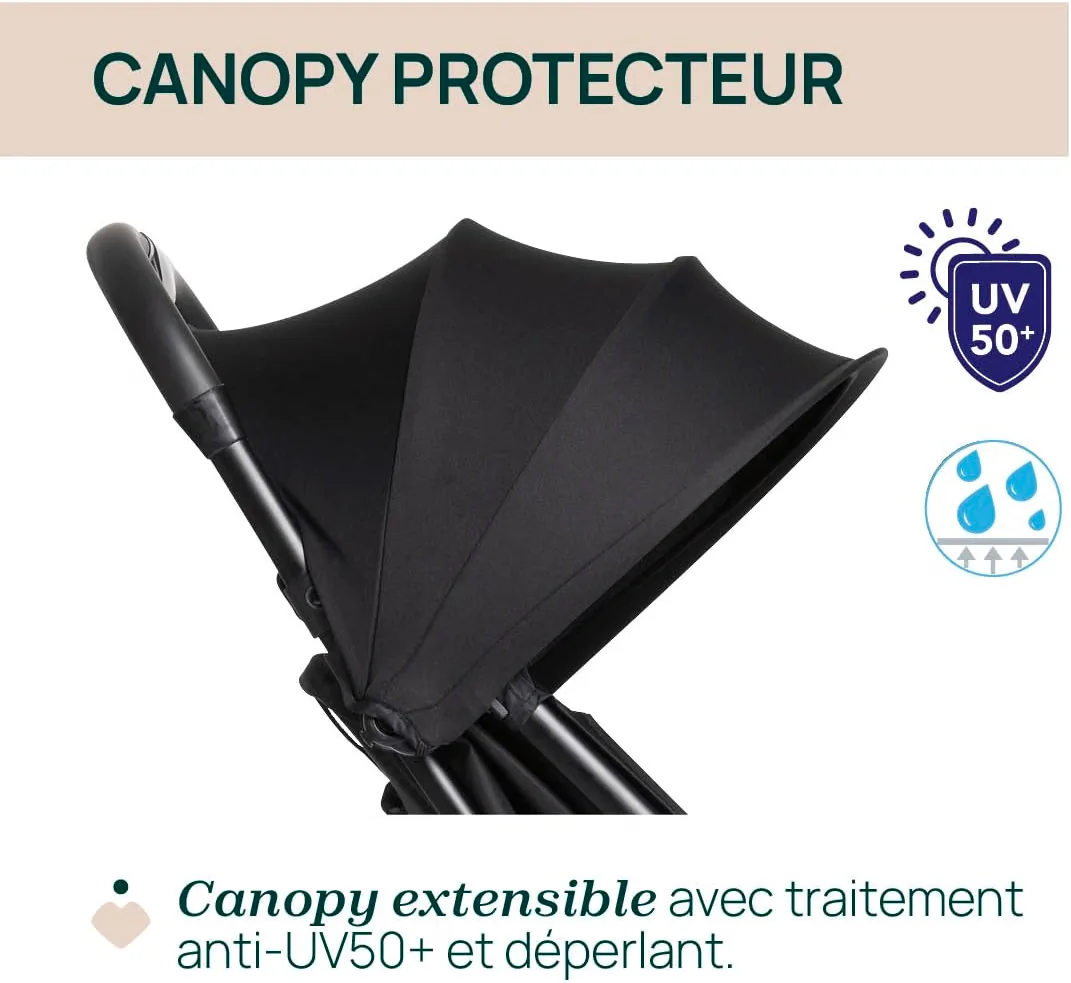
- Extend the canopy on the sunny side. A UV-treated canopy, like the Urbino's, filters the rays over the area it covers.
- Cover the skin with light, long, loose clothing, and a wide-brimmed hat for an older child.
- Think about the eyes: suitable sunglasses for a child who accepts them, recommended by the French public health website for exposed children.
- Add a parasol clipped to the frame if the canopy is not enough.
The canopy does not move with the sun. During the walk, the light shifts: check regularly that your child stays in the shade.
Heat and heatwaves
Babies regulate their temperature poorly. The French public health agency, in its advice on the first 1,000 days, points out that a baby loses more water each day than an adult and finds it harder to regulate their temperature, which increases certain risks in hot weather. The Quebec public health institute adds that babies should be kept from sweating.
In hot weather:
- Move outings to early morning or evening, or postpone them.
- Lighten clothing: a light bodysuit may be enough in the shade.
- Offer drinks often, according to age and your doctor's advice.
- Lower the backrest and open any canopy vents, to let air circulate.
- Never leave your child in a car, even for a few minutes.
- Watch for signs: a baby who is red, sweaty, restless or unusually drowsy.
The muslin-on-the-stroller trap
This is the most common and most counter-productive summer habit: throwing a muslin, a thin blanket or a towel over the canopy for shade. The intention is good; the result is the opposite of what you want.
The Quebec public health institute explicitly advises against it: when it is very hot, do not cover the stroller with a blanket, even to protect your baby from the sun, because the temperature inside rises quickly. An often-cited experiment by a paediatrician at Astrid Lindgren Children's Hospital in Stockholm placed two empty strollers fitted with thermometers in the sun: after 90 minutes, the covered one reached about 37 °C, against 22 °C for the one left uncovered. The air stops circulating and heat builds up under the fabric.
What to do instead? Seek shade, use the canopy alone, add a stroller parasol, which gives shade without trapping the air, and move your outings.
Cold
In cold weather, a stroller has an advantage over a baby carrier. The French public health website advises, if you have to go out in severe cold, choosing a pram or stroller, because a carrier can compress the legs and increase the risk of frostbite to the legs and feet. It also recommends covering the extremities well: head, hands and feet.
- Layer up rather than using one very thick garment.
- Cover the head with a hat, the hands with mittens, the feet with warm booties.
- Use a footmuff or a blanket laid over your child, well tucked in.
- Adjust the harness over the clothes: a thick coat under loose straps reduces support. A thin snowsuit with a blanket over the harness is better.
- Extend the canopy against the wind.
- Uncover your child as soon as you enter a heated shop or bus, then cover them again on leaving.
A baby who is too hot sweats and can then get cold. Touch the back of their neck: warm and dry is good; damp means too many layers; cool means add one.
Rain
A water-repellent canopy, like the Urbino's, makes drops bead during a light shower. It is not waterproof: in steady rain, water eventually gets through, and your child's legs stay exposed. To go out in the rain, you need a rain cover suited to the stroller. The retailers we checked do not list one among the Urbino's accessories: plan for one if you go out in all weathers.
- Choose a rain cover suited to your stroller's dimensions, with ventilation.
- Do not leave it on in the sun or in a heated place: heat and humidity build up underneath.
- After the outing, wipe the frame and let the stroller dry open, canopy extended, before folding it.
Wind
Wind quickly chills a baby who is not moving, even at a mild temperature. Turn the canopy into the wind, cover head and neck, and avoid long walks by the sea or on high ground in strong wind. A lightweight stroller also catches the wind: always keep one hand on the handlebar and apply the brake at every stop, however brief.
The seasons table
| Season | Best times | Equipment | Avoid |
|---|---|---|---|
| Summer | Early morning, late afternoon | Light covering clothes, canopy, parasol, water | 12 noon to 4 pm, muslin over the canopy, a closed car |
| Autumn | Middle of the day | Cardigan, light hat, rain cover | Staying wet, folding the stroller damp |
| Winter | Middle of the day | Snowsuit, hat, mittens, footmuff | Thick coat under the harness, too many layers indoors |
| Spring | Variable | Layers, canopy, rain cover | Underestimating the sun on the first fine days |
Dressing your baby for the stroller
A baby in a stroller barely moves: they get colder than a parent who is walking. A rule often given is to dress them like an adult, plus one extra layer. Then adjust with experience: a still child in winter needs an extra layer; a child sleeping in the summer sun needs fewer.
A few simple principles:
- thin layers, easy to remove;
- head, hands and feet covered when it is cold;
- no cords or long ties that could catch in the wheels or joints;
- the harness always adjusted to the day's outfit.
Naps during the walk
Many children fall asleep in the stroller. It is a precious moment that needs a few precautions:
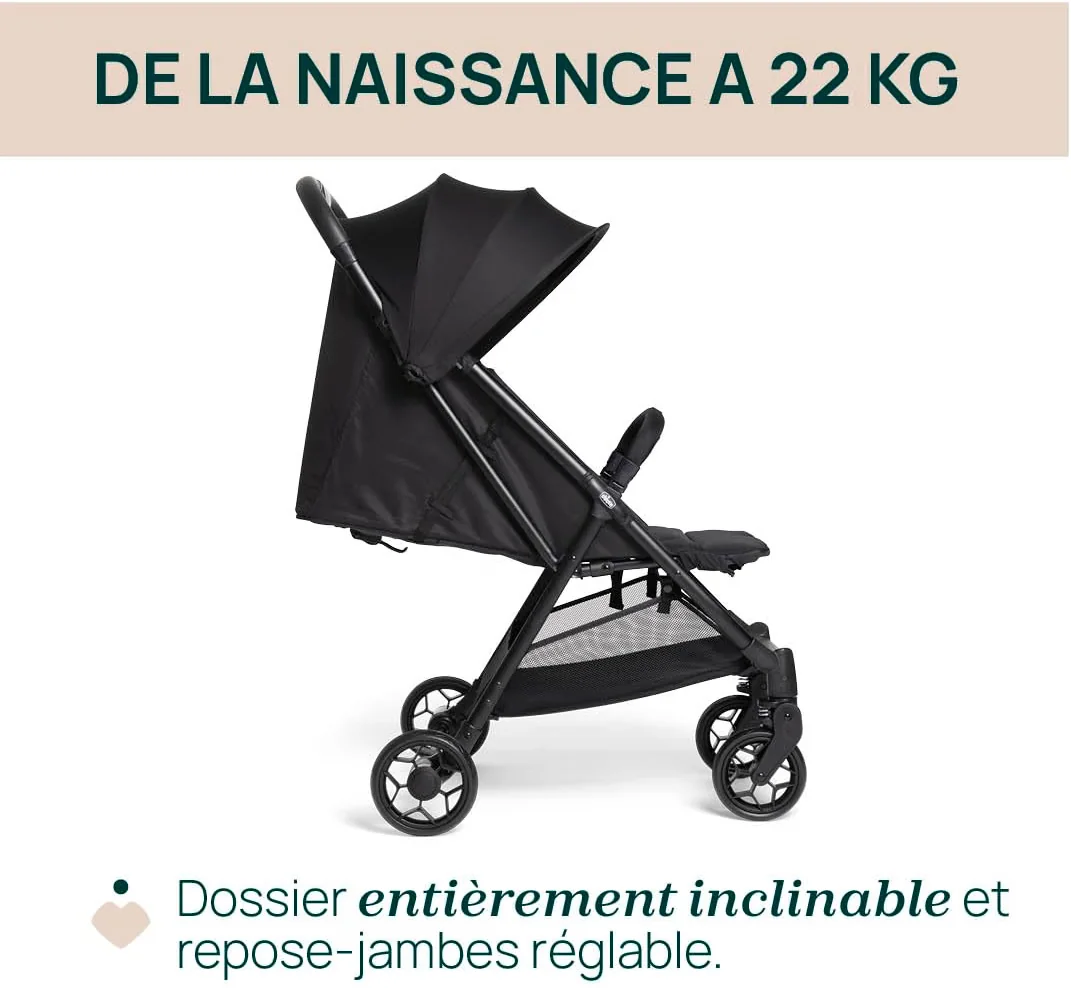
- Lower the backrest so the head does not fall forward; for a tiny baby, keep the lying position.
- Keep the harness fastened.
- Check that no blanket slides over the face.
- Stay close: never leave your child sleeping alone in the stroller, even in the building's hallway.
- For a long nap at home or for the night, put them in a proper cot.
A backrest you can adjust with one hand, without jolting, lets you go from awake to nap without waking your child. On the Urbino, the adjustment strap at the back of the seat does just that.
On the pavement: good habits
- At pedestrian crossings, do not push the stroller into the road before checking that vehicles are stopping: it sticks out in front of you.
- At kerbs, press down on the handlebar to lift the front wheels, then lift the rear wheels up. Going down, back down if the step is high.
- On a slope, keep both hands on the handlebar. Never let go of the stroller, even for a second.
- When stopped, apply the brake, even on a pavement that seems flat.
- At night or in poor visibility, make yourself visible (see below).
At the park, the market, in the woods
At the park, gravel paths are more comfortable with the front wheels locked straight. Keep the stroller away from sandpits: sand gets into the wheels and joints.
At the market, a narrow stroller you can steer with one hand gets between the stalls. Put purchases in the basket without exceeding its load, and never on the handlebar.
In the woods or on a track, a lightweight stroller quickly reaches its limits: roots, ruts, mud. Stay on firm paths. For hiking, a suitable baby carrier or an all-terrain stroller is more appropriate.
Going out at dusk
In winter, night falls early, and nursery pick-up often happens in the half-light. A low, dark stroller is hard for a driver to see. Add a reflective strip or a small light clipped to the frame, wear something light yourself, and cross at lit crossings.
Parents need comfort too
A walk that is pleasant for your child should be pleasant for whoever is pushing too. Wear comfortable shoes, keep your shoulders relaxed and push with your arms rather than your back. If the handlebar is too low for you, shorten your stride slightly and avoid leaning over. On the Urbino, the handlebar is not adjustable: Chicco gives a height of about 102 cm for the US version.
Enjoy the walk for yourself too: a phone call, a podcast at low volume with one ear free, a coffee on a shaded terrace. Daily outings last when they are a shared pleasure.
A routine that makes everything easier
Parents who go out every day without stress often have a well-oiled routine:
- the walk bag always ready, restocked on return;
- the stroller stored open or folded in the same place, by the door;
- the rain cover and footmuff in the basket during the cold season;
- a usual route, familiar and obstacle-free;
- a regular time, fitted around naps.
A stroller that folds with one hand and stands on its own makes these routines even simpler: it waits in the hallway without getting in the way.
First outings with a newborn
The first walks with a newborn need a little more preparation. Check that the stroller is approved from birth, backrest in the lying position and leg rest raised. Adjust the harness snugly, shoulder straps at the lowest height. Cover your baby for the weather, with a blanket laid over them and tucked under the arms, never over the face or the canopy. Choose a short, familiar route and a moment when the baby has just fed. Our article on lightweight strollers from birth explains the set-up.
Do not set yourself a target duration: what matters is going out, finding your bearings and going home when the baby asks. Over the days, outings will naturally get longer.
Pollution, pollen and city air
In the city, a child in a stroller breathes at exhaust-pipe height. A few simple choices limit their exposure: favour quiet streets, parks and pavements away from main roads; avoid waiting at the edge of a busy road, for example at a traffic light, by stepping back a few paces; move the walk during pollution episodes announced by your local authorities. In spring, if your child is sensitive to pollen according to their doctor, outings after rain or late in the day may be more comfortable.
Making the walk interesting for your child
For a wakeful baby, the walk is a show: moving leaves, street noises, faces, dogs. Raise the backrest slightly once they hold their head well so they can see around them. Talk about what you see, name things, sing. Stop at the park to take them out of the stroller, cuddle them, lay them on a blanket. Avoid hanging toys with long ties near their face; choose a small toy they hold in their hand, attached with a short strap designed for the purpose.
When your child walks: stroller and little steps
At around 18 months or two years, your child wants to walk, then run, then refuse the stroller. It remains precious for long distances and naps all the same. Alternate: a few minutes on foot on a quiet pavement, holding their hand, then back into the stroller when they tire. A lightweight stroller you push with one hand leaves the other free for them. Always fasten the harness as soon as they climb back in, even for a few metres, and do not let them push the stroller alone near the road.
When the weather changes along the way
A sudden shower, a rising wind, a sun breaking through: the weather sometimes changes mid-walk. Keep a small emergency kit in the basket depending on the season: folded rain cover, light cardigan, warm hat, sun hat. In a shower, extend the canopy and the rain cover, then head home or take shelter; do not stay out long with a wet child. If the sun gets strong, seek shade immediately and cut the outing short. Back home, dry the stroller open and the rain cover separately.
Adapting the length to age
There is no ideal duration, but a few common-sense guidelines help. With a newborn, short, frequent outings leave time to feed and change them between walks. At a few months, when your child stays awake longer and takes an interest in their surroundings, walks can get longer, with breaks to take them out of the stroller. Between one and four, your child alternates walking and riding, and the walk is organised around what they want: a park, a slide, a snack. At any age, their signals are what count: crying, restlessness, yawning, cold hands or a damp neck mean it is time to change something.
Walking the dog with the stroller
Many parents walk the dog at the same time as the baby. It is possible but calls for care. Never tie the lead to the stroller: a dog that pulls or bolts can tip it over. Hold the lead in one hand and the handlebar in the other, with a calm dog used to walking to heel. With a dog that pulls, make two separate outings or go with two adults. Keep the brake on at every stop, while the dog sniffs or you pick up after it.
Coming home
The walk only really ends once the stroller is put away. When you get home, uncover your child so they do not overheat indoors, empty the basket, shake out crumbs and wrappers, and let the stroller dry open if it is damp. Restock the walk bag straight away: nappies, wipes, change of clothes. The next outing will then start in two minutes, and the stroller will stay clean and ready.
Fitting the walk to your child's rhythm
The best walk is the one that respects your child's rhythm. Just after a feed, a full baby often falls asleep to the motion: the ideal moment for a long, quiet walk. A child who is tired but not yet asleep may instead get cross at being strapped in: a short outing, then a return to calm, is better than a long trip in tears.
Watch for the times when your child is most receptive and fit outings around them. Leave room for the unexpected: a change, a feed, a break at the park. A walk that ends well makes you want to go again the next day, and it is regularity that counts, more than the length of each outing.
Common mistakes
- Covering the canopy with a muslin in summer.
- Going out between 12 noon and 4 pm with a baby in high summer.
- Leaving the harness loose over a thick coat.
- Believing the water-repellent canopy protects from a downpour.
- Leaving the rain cover on in a heated place.
- Hanging shopping bags on the handlebar.
- Leaving your child sleeping alone in the stroller.
- Folding the stroller while wet.
Common beliefs about walks
Some ideas about outings with a baby are passed on from one generation to the next. A few are worth looking at again.
- "Babies should not go out before a certain age." Health authorities, including the Quebec public health institute, point out that a healthy baby can go outside every day as long as the temperature is reasonable and they are dressed appropriately. If in doubt, ask your doctor.
- "A covered stroller stays cooler." The opposite is true: fabric over the canopy traps heat, and the temperature underneath rises quickly. Shade and a parasol work better.
- "A baby in a stroller needs as many layers as possible in winter." Too many layers make a baby sweat, then get cold. Thin layers, covered extremities and a footmuff over the harness are more effective.
- "The canopy is enough in the rain." A water-repellent canopy only holds for a short shower. For real rain, you need a rain cover, removed once indoors.
The common thread: watch your child rather than follow fixed rules, and adapt the outing to the weather of the day.
What the Urbino brings to walks
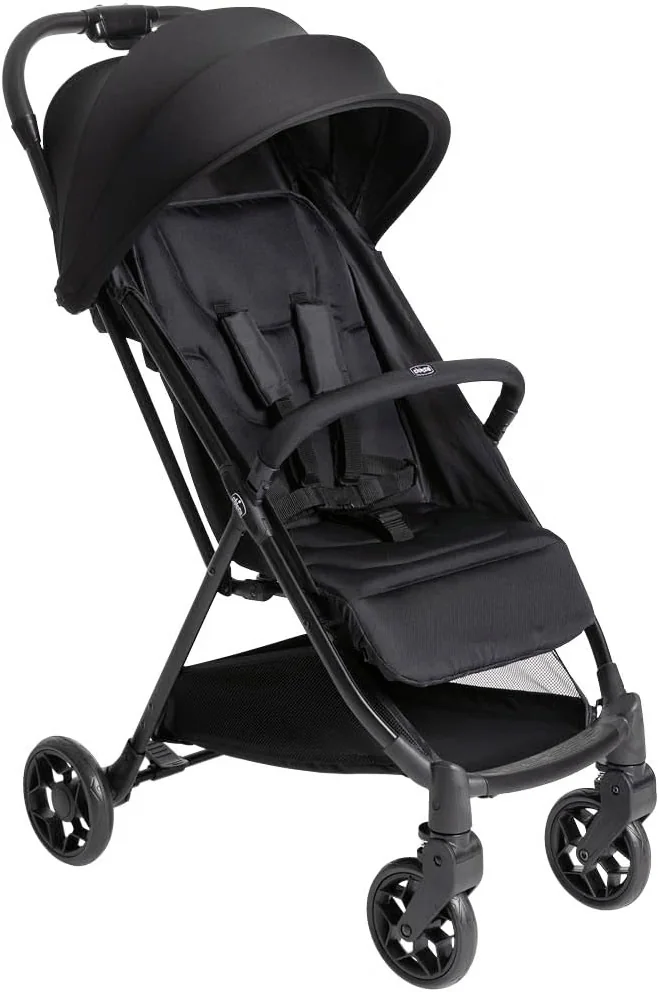
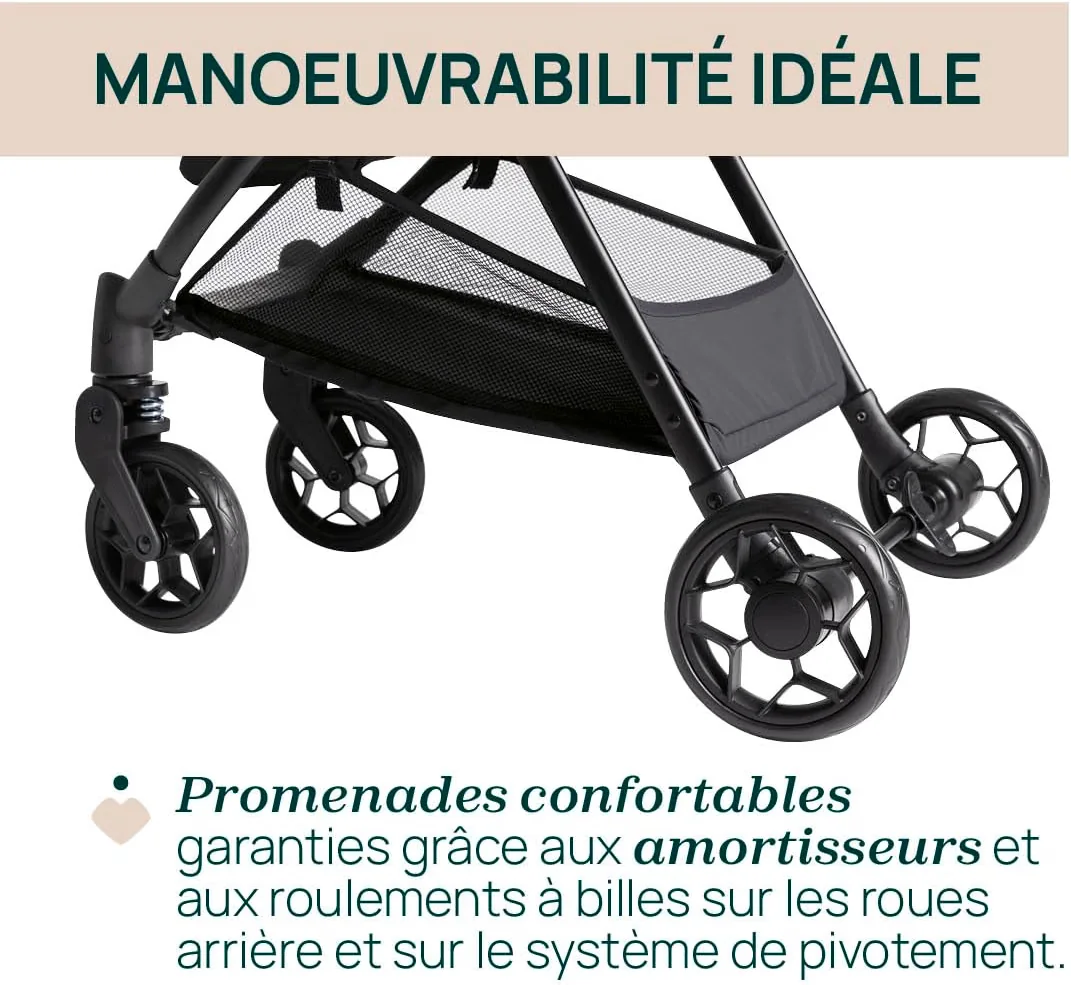
For these daily outings, the Urbino has concrete strengths: an extendable UPF 50+, water-repellent canopy, a backrest that lies flat for naps, shock absorbers that smooth out pavements, a weight of 6.3 kg and a one-hand fold for the bus home. Its limits are also those of a compact: a modest basket and no rain cover listed in the box. Our full review covers each point.
Frequently asked questions
Above or below what temperature should you not go out with a baby?
There is no single threshold. In hot weather, move outings to cooler hours; in severe cold, limit the duration and cover the extremities well. If in doubt, ask your doctor.
Can you put sun cream on a baby?
For a baby under 6 months, ask a health professional first. Shade and clothing remain the priority.
Is a stroller parasol useful?
Yes, it gives shade without trapping air, unlike fabric laid over the canopy.
Do you need a footmuff?
In winter, it is very practical: it keeps the legs warm and goes over the harness.
Can you go out in the rain with a lightweight stroller?
Yes, with a suitable rain cover. The canopy alone is not enough in a real downpour.
How long can a walk last?
It depends on age, weather and the child. Watch their signals and take breaks to feed, change and cuddle them.
Can you go out with a baby during a pollution peak?
Follow your local authorities' recommendations. Favour parks and quiet streets away from main roads, and move the walk if necessary.
Does a baby need a hat in summer?
For a baby in the shade, a light wide-brimmed hat protects from the sun. A warm hat is for the cold: in summer it makes them sweat. Remove the sun hat if your child falls asleep in the shade and is hot.
How can I tell if my baby is too hot in the stroller?
Touch the back of their neck: damp and hot means too many layers or too hot. A baby who is red, restless or unusually drowsy in hot weather should be cooled down and watched.
Ready for the first walks?
From birth · 6.3 kg · One-hand fold · UV 50+ canopy. Price and colours change often on Amazon: check them, as well as the seller and the accessories included (a rain cover is not always supplied), before you order.
Check the price on AmazonAffiliate link · new tab